What the Greater Cambridge Local Plan is
1.1. A Local Plan is a legal document that the Councils are required to prepare that sets out the future land use and planning policies for the area over a set time frame. It identifies the need for new homes, jobs and infrastructure to support them, and guides where this development should happen. It provides planning policies that are used in the determination of planning applications alongside national planning policy.
1.2. Cambridge City Council and South Cambridgeshire District Council have worked together to create a joint plan for the two areas, referred to as Greater Cambridge (as shown in Figure 1). This will ensure that there is a consistent approach to planning with the same planning policies implemented across both areas. This Local Plan covers the period between 2024 and 2045, although some of the developments it identifies will take place over a longer period.
1.3. The Local Plan has been prepared through extensive engagement with our communities, stakeholders, and organisations. A wide range of evidence has been produced to support the policies and site allocations. Its overarching objective is to deliver sustainable development, to protect and enhance our natural and built environment, to support health and vibrant communities, and a successful and innovative economy. Its policies and proposals will help shape the places we live, work and visit for decades to come.
A portrait of Greater Cambridge
The Greater Cambridge people
1.4. The Greater Cambridge area encompasses the city of Cambridge and the predominantly rural district of South Cambridgeshire. The area includes a world-renowned city, newly emerging towns of Cambourne, Northstowe and Waterbeach, a series of necklace villages close to Cambridge forming a total of around 100 villages.
1.5. According to ONS data, Cambridge’s population is among the fastest growing in the country, increasing from 145,700 in 2021 to 150,000 in 2023; South Cambridgeshire’s population stands at 163,000. This growth reflects both the areas economic attractiveness and its dynamic and shifting population. Whilst Greater Cambridge continues to attract young working adults and students, long-term demographic trends highlight a rapidly ageing population. Forecasts suggest that by 2031, the number of people aged 65 or over will grow by a further 26%, the majority of whom will be in the over-80s age band.
1.6. Greater Cambridge contains many economically and culturally affluent areas, however, there is a complex picture of inequality, with not everyone participating in, or benefiting from the areas socio-economic success or access to opportunities. Whilst housebuilding rates are rising and affordable housing is a required element of new development, the continued increase in house prices relative to local wages remains a growing concern for many residents. Disparities in income, health outcomes, and access to services impact on the quality and inclusivity of service provision, including amongst Gypsy and Traveller communities, older residents, and people on lower incomes.
The Greater Cambridge economy
1.7. Greater Cambridge is home to an internationally significant and well-established network of employment clusters, particularly in life sciences, information technology and advanced manufacturing, supported by two major universities. These knowledge intensive clusters play a pivotal role in sustaining Greater Cambridge’s economic momentum and comprise some of the fastest-growing industry sectors in the UK. They have seen remarkable growth, with employment increasing by 3.0% between 2018 and 2024, more than double the 1.3% growth rate for these sectors seen across Great Britain. In the 2025 Global Innovation Index, Cambridge was ranked the second most intense innovation cluster globally. Greater Cambridge sits at the heart of several economic corridors: the Oxford Cambridge Growth Corridor, the UK Innovation Corridor (London-Stansted-Cambridge-Peterborough) corridor and the Cambridge-Norwich Tech Corridor.
1.8. While these sectors are among the most prominent, the local economy is also diverse. The contribution of Greater Cambridge’s education, retail, health, tourism, transport and agriculture sectors is crucial, providing a variety of employment opportunities and supporting the economic, social and environmental wellbeing of the area and its residents. The growth in employment, productivity and local start-ups of the area has created a rising demand for new employment floorspace, supporting infrastructure, a skilled and diverse workforce and a growing need for logistics and associated transport networks.
The Greater Cambridge environment
1.9. The Greater Cambridge landscape varies with river valleys, contrasting with open fens, wooded clay lands and ridges, and rolling chalk hills. A range of wildlife species and habitats are present. It is home to precious chalk streams which are rare at a global level. Greater Cambridge also includes a rich mix of designated heritage assets. Built around the banks of the River Cam, Cambridge is a distinctive and iconic historic University city; equally, South Cambridgeshire villages contain many beautiful historically significant buildings and Conservation Areas, alongside sites recognised for their ecological, architectural and biodiversity value. As of 2025, the total number of listed buildings across Cambridge and South Cambridgeshire stands at 3,530.
1.10. Climate change is an escalating challenge, both globally and in Greater Cambridge. The area is already starting to feel the effects, such as more frequent and intense weather events, a rising risk of flooding and increasing pressure on water supplies. In response, climate adaptation and mitigation are now central to many policy initiatives, including the proposed Fens Reservoir, planned to be operational between 2035 and 2037, which will play a vital role in securing long-term water supply and resilience for the region.
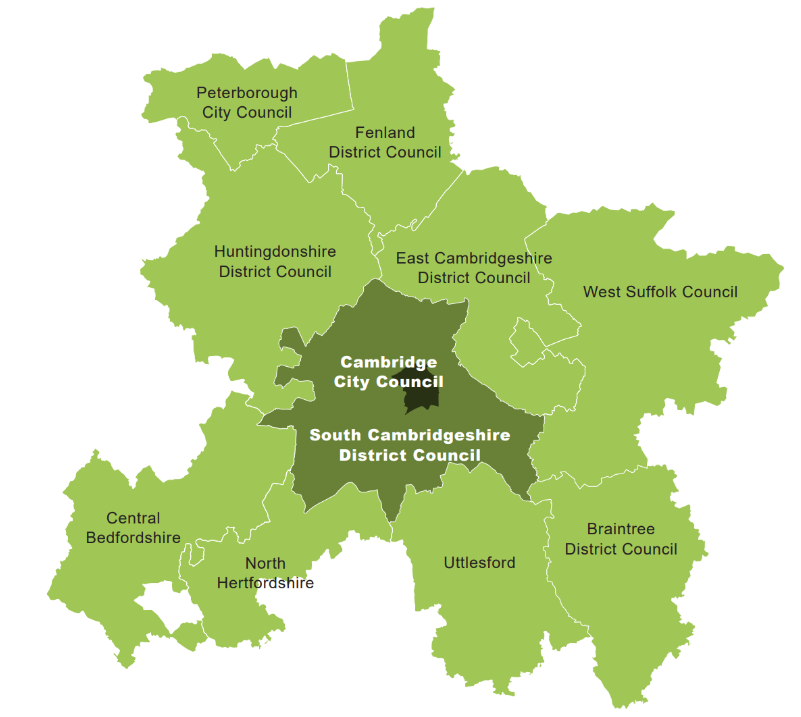
Figure 1: Map of the Greater Cambridge area
How it relates to other plans and strategies
1.11. The policies in the Local Plan form part of the Development Plan for the area, along with the Cambridgeshire and Peterborough Minerals and Waste Plan, and ‘made’ Neighbourhood Plans produced by local communities for their designated areas. When it is adopted, the Greater Cambridge Local Plan will supersede the currently adopted local plans:
1.12. The following Area Action Plans which provide guidance to specific areas will also no longer be part of the development plan when the Greater Cambridge Local Plan is adopted:
- Cambridge East Area Action Plan (2008)
- North West Cambridge Area Action Plan (2009)
- Cambridge Southern Fringe Area Action Plan (2008)
- Northstowe Area Action Plan (2007).
Council strategies
1.13. The Local Plan will play a key role in meeting the objectives set out in both Cambridge City Council and South Cambridgeshire District Council’s corporate plans.
Cambridge City Council’s Corporate Plan from 2022 to 2027
- Vision: ‘One Cambridge, Fair for All’.
- Four key priorities for 2022 to 2027:
- Leading Cambridge’s response to the climate and biodiversity emergencies and creating a net zero council by 2030
- Tackling poverty and inequality and helping people in the greatest need
- Building a new generation of council and affordable homes and reducing homelessness
- Modernising the council to lead a greener city that is fair for all.
South Cambridgeshire District Council’s Corporate Plan from 2025 to 2030
- Vision: ‘Our vision is for a fairer, kinder, and greener South Cambridgeshire, where all residents will be equal partners in their communities.’
- Priorities:
- Healthy and supported communities
- Sustainable homes and vibrant places
- Being green to our core
- Helping businesses to thrive in South Cambridgeshire
- Financially secure and fit for the future.
National context
1.14. This plan is being produced under the legacy plan making system, which covers plans to be adopted under the Planning and Compulsory Purchase Act 2004, excluding the amendments made by the Levelling-up and Regeneration Act 2023, and The Town and Country Planning (Local Planning) (England) Regulations 2012.
1.15. The Local Plan is informed by the National Planning Policy Framework (NPPF), which provides guidance for local planning authorities on how to prepare local plans and make decisions on planning applications. The NPPF is supported by more detailed guidance in Planning Practice Guidance (PPG). The Local Plan does not seek to repeat the NPPF. It provides locally specific planning guidance reflecting the needs and opportunities of the area.
1.16. The government published a draft NPPF for consultation between 16 December 2025 to 10 March 2026, containing significant revisions to national planning policy and a set of national development management policies. A final version of the revised NPPF has not yet been published at the time of preparation of this plan. As this local plan being produced under the legacy plan making system, its soundness in relation to consistency with national policy will be considered against the NPPF 12 December 2024.
Regional context
1.17. We work closely with bodies like the Cambridgeshire and Peterborough Combined Authority, who are the Local Transport Authority responsible for preparing the Local Transport Plan for the county, and Cambridgeshire County Council, who are the Highway Authority and responsible for a range of issues such as education.
1.18. Our new Local Plan is being prepared within a wider regional context. We have a legal duty to cooperate with key stakeholders and surrounding areas on strategic cross boundary issues. Our discussions with surrounding authorities and stakeholders have helped to shape the Local Plan.
Our neighbourhoods and local areas
1.19. Neighbourhood planning allows communities to prepare plans for their own designated areas, which become part of the Development Plan. Neighbourhood plans must align with the strategic policies of the Local Plan, and not propose policies that would result in less housing provided by means of development taking place in that area than if the neighbourhood plan was not to be made. At the time of publishing, there are 14 plans already in place across Greater Cambridge, and further plans are underway. More information can be found on our website.
Working with Government and the Cambridge Growth Company
1.20. In October 2024 the government issued a statement on Realising the Full Potential of Greater Cambridge. This highlighted that the economic growth of Cambridge has been a phenomenal success and the potential to make an even greater contribution to the UK economy. There remain significant barriers which are impeding further growth.
1.21. The government has established the Cambridge Growth Company to work with local partners to develop and start to deliver an ambitious plan for delivering high quality sustainable growth in Cambridge. Their work is focused on unlocking and accelerating development, preparing the evidence base to support development of an infrastructure-first growth plan, and identifying solutions to complex planning constraints that effect the area.
1.22. This Local Plan is based only upon the Councils’ own evidence following a standard approach to local plan-making. The government and the Cambridge Growth Company acknowledge the importance of the Local Plan and want to support its development in order to provide a strong foundation to consider any future wider considerations of growth in the Cambridge area.
1.23. In June 2026 the Government confirmed it would be establishing a Development Corporation for Greater Cambridge. This will take on some planning functions for the area in future. The production of this local plan remains with the Councils, with the Development Corporation supporting its progression.
Our plan-making journey
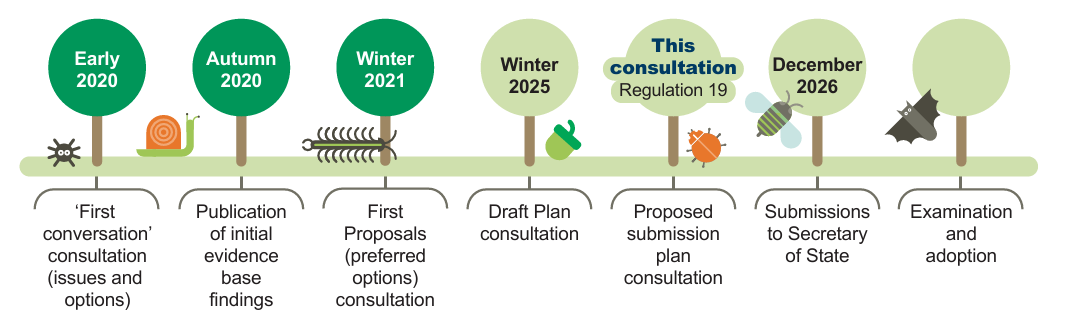
Figure 2: Our plan-making journey
1.24. Figure 2 shows the stages of plan-making so far, and the next stages. Our plan making journey started back in 2019 with a series of workshops with stakeholders about issues and themes that would be important to the plan. In early 2020 we held a six-week public consultation called the First Conversation, followed by the publication of findings in November 2020 Our First Proposals consultation took place at the end of 2021 that set out our preferred approach for growth and policies to guide it. We published a report on the consultation and all the comments received in 2022. In 2023 we published a Development Strategy Update, where we considered the outcomes of the consultations and key parts of the emerging development strategy.
1.25. In December 2025 to January 2026, we consulted on the draft Local Plan to seek views and feedback before preparing this Proposed Submission version of Plan.
1.26. You can find the documents from all these previous stages in our Document Library. We have also published an update to our Statement of Consultation, which shows how we have taken account of comments received at previous stages, including the Draft Plan consultation.
The current Proposed Submission Local Plan (Regulation 19) stage
1.27. This current stage of consultation is on the Proposed Submission (Regulation 19) Greater Cambridge Local Plan. This stage provides opportunity to comment on the ‘soundness’ of the Plan and whether it has been prepared in accordance with legal and procedural requirements. Both terms are defined in national planning policy.
1.28. The four tests of soundness, set out in the National Planning Policy Framework, require the Local Plan to be:
- Positively prepared - Providing a strategy which, as a minimum, seeks to meet the area’s objectively assessed needs and is informed by agreements with other authorities, so that unmet need from neighbouring areas is accommodated where it is practical to do so and is consistent with achieving sustainable development.
- Justified - An appropriate strategy, taking into account the reasonable alternatives, and is based on proportionate evidence.
- Effective - Deliverable over the plan period and is based on effective joint working on cross-boundary strategic matters that have been dealt with rather than deferred, as evidenced by the statement of common ground.
- Consistent with national policy - Enabling the delivery of sustainable development in accordance with the policies in this Framework and other statements of national planning policy, where relevant.
1.29. If you wish to send in your views, it will be important that you make clear whether you support or object to the Plan. If you are objecting to the Plan you will need to set out what changes to the Plan would resolve your objection.
1.30. Consultation will take place between 3 August 2026 and 25 September 2026. For details and guidance on how to make representations and to sign up for Local Plan updates please visit the Greater Cambridge Shared Planning website at www.greatercambridgeplanning.org/local-plan. If you require further assistance on how to submit comments, please email localplan@greatercambridgeplanning.org or telephone 01954 713183.
1.31. Any comments submitted at the Regulation 19 consultation will be formally submitted to the Secretary of State for Housing, Communities and Local Government together with the Local Plan and supporting evidence base. We are aiming to complete this before the end of 2026, reflecting the target for plan-making set by the government. A Planning Inspector will then conduct an independent Examination of the Plan. If the Planning Inspector concludes that the plan is ‘Sound’ it will be formally adopted.
Structure of the document
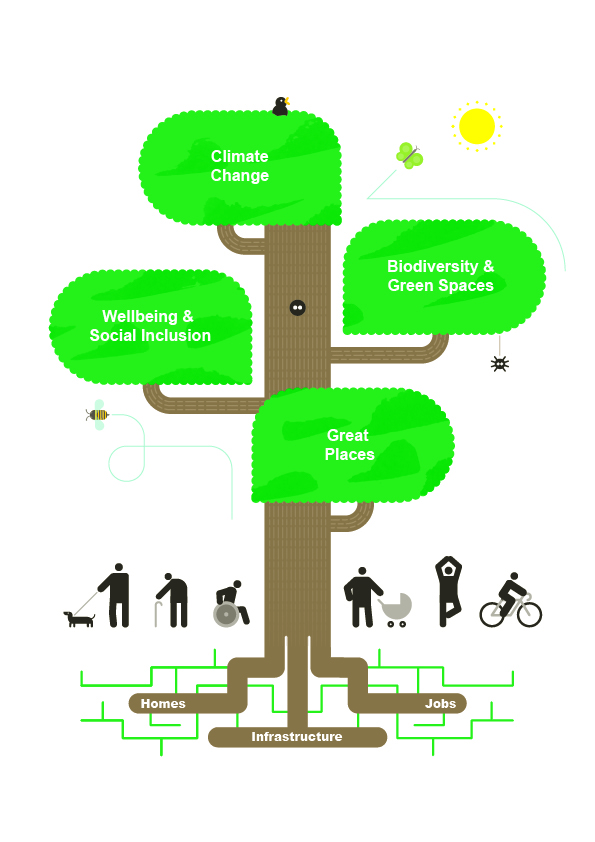
Figure 3: Greater Cambridge Local Plan themes
1.32. Our Local Plan seeks to provide a positive vision for the future of Greater Cambridge. The aim is to ensure sustainable development. Sustainable development has three strands – social, economic and environmental. It means meeting the needs of the present population without compromising the ability of future generations to meet their own needs.
1.33. To properly reflect the three strands of sustainable development, we must plan for homes, jobs and supporting infrastructure (transport, utilities, services and facilities) in the right places, alongside protecting and enhancing the environment. Through the engagement with people on our plan-making journey, we have developed the plan around our ‘themes’ that will influence how homes, jobs and infrastructure are planned.
1.34. In addition to the themes, the Local Plan includes the development strategy that sets out the proposed policies and sites that are proposed to meet our needs in Greater Cambridge to 2045 and beyond.
1.35. The Local Plan policies are therefore structured into eight areas:
- Development strategy
- Climate change
- Biodiversity and green spaces
- Wellbeing and social inclusion
- Great places
- Jobs
- Homes
- Infrastructure
1.36. It is important to note that when the plan is being used to make decisions, it should be read as a whole. Development proposals will be decided against all relevant policies.
How the policies work
1.37. Local Plans are made up of a series of planning policies. Planning policies are used in determining decisions on planning applications.
1.38. Each policy contains the following information:
- Policy reference and name: A code, made up of a two-digit code for the theme and then for the individual policy (for example, GP would be Great Places and GP/AR, would be for archaeology policy).
- What the policy does: The planning policy itself.
- Supporting information: Context and guidance for interpreting planning policies, also known as the supporting text of the policy.
1.39. The plan is also made up of site specific allocations in the Cambridge urban area, at the edge of Cambridge, in new settlements, the rural southern cluster and the rest of the rural area. For strategic site allocations, we have used headings from the National Model Design Code that cover the identity, uses, context, built form, public space, nature, movement, resources and lifespan.
The Policies Map
1.40. The Proposed Submission (Regulation 19) Greater Cambridge Local Plan is accompanied by a Policies Map that shows how all of the policies apply to different geographical areas.
1.41. The easiest way to view the map is on our website, where you can use our interactive map to find the areas you are interested in, and view individual map layers. Our digital Local Plan consultation platform also provides direct links between the Policies Map and relevant site allocations and plan policies.
Evidence supporting the Local Plan
1.42. The Local Plan has been informed by a wide range of evidence. This can be found in our Document Library.
1.43. The Local Plan is accompanied by a Sustainability Appraisal / Strategic Environmental Assessment (which explores the sustainability of the strategy and policies and reasonable alternatives), a Habitat Regulations Assessment (HRA) which assesses the likely impacts of the plan on the integrity of national and European designated nature sites, and an Equalities Impact Assessment (EqIA).
Tell us what you think
For further guidance on how to submit comments, please see the Representation Guidance Note.
All comments must be received by 25 September 2026 at 5pm.