Policy BG/UGF: Urban Greening Factor
1. All major development proposals must include the latest version of Natural England's Urban Greening Factor User Guide and User Guide Spreadsheet, demonstrating how the development will achieve Urban Greening Factor scores of at least:
- 0.3 for predominantly commercial development;
- 0.4 for predominantly residential development within Cambridge Defined Development Extent; or
- 0.5 for predominantly residential development outside Cambridge Defined Development Extent, except where it can be demonstrated that more than 50% of the site area equates to accessible greenspace.
2. Where development is proposed in multiple phases, the relevant standard will apply to the development as a whole rather than to individual phases. Outline applications must be supported by a phasing strategy, set out in a GI Statement and GI Plan, demonstrating how key recreational green spaces and green infrastructure will be delivered early in the programme, with appropriate provision made available in advance of, or alongside, the occupation of new homes.
3. The Green Infrastructure secured by the Urban Greening Factor should be secured in the GI Operation and Maintenance Plan.
Supporting information
5.47. Urban greening means the incorporation of plants, trees, and other natural elements into urban environments to create more sustainable, liveable, and resilient places. Major development proposals should contribute to the greening of Greater Cambridge by including urban greening - via the Urban Greening Factor (UGF) - as a fundamental element of site and building design, and by incorporating measures such as high-quality landscape (including trees), green roofs, green walls and nature-based sustainable drainage. Meeting UGF can help to meet other policy requirements and provide a range of benefits including amenity space, cooling, enhanced biodiversity, sustainable drainage and amenity.
5.48. UGF is a technical, quantitative development management design tool, rather than a strategic, network-level policy. UGF ensures that all new development contributes to the delivery of high quality GI at site levels and provides a figure for the proportion of urban greening in comparison to the total area of the development site. It is calculated by multiplying the area of each surface cover type by its “factor” – a weighting factor from 0.0 to 1.0 assigned to each cover type reflecting its environmental and social value in urban greening; its functionality in providing ecosystem services, including improving permeability; and its benefit in supporting biodiversity and habitat creation. Each figure is then added together and divided by the total area within the development site.
5.49. The resulting score is then compared with the target UGF score for the development site set by the planning policy and the score indicates whether the urban greening proposals achieve, exceed or fail to meet the defined target.
5.50. UGF weighting factors reward, and the policy encourages, the retention, planting and integration of trees within proposed development schemes.
5.51. Both UGF and BNG require consideration early in the design process (both being concerned with greening and affecting site layout), and a design team should be considered alongside one another as integral to planning the layout and design of new buildings and developments. However, meeting the minimum UGF score does not automatically mean the proposal meets all relevant design, biodiversity or landscape standards; and UGF features must be designed to be functional, resilient and appropriate to context.
5.52. To calculate UGF applicants should use Natural England’s Urban Greening Factor User Guide and supporting User Guide Spreadsheet as set out in the Natural England GI Framework, using relevant surface cover types and weightings.
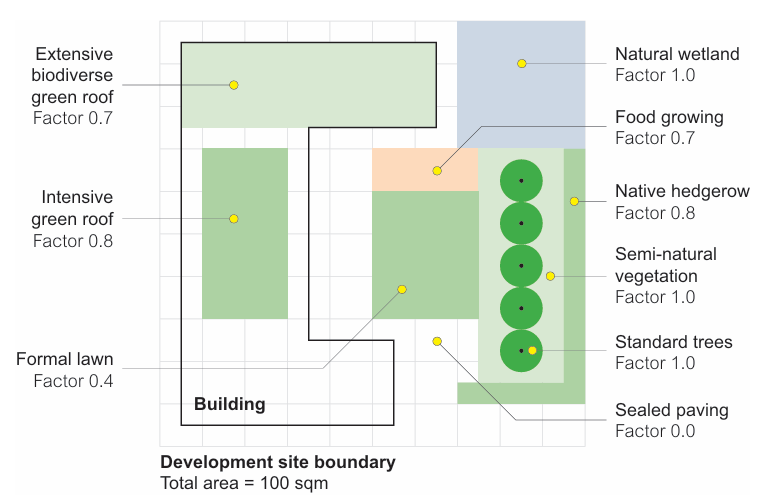
Figure 110: Theoretical site plan showing UGF scores from the Natural England Urban Greening Factor for England User Guide (2023).
Tell us what you think
For further guidance on how to submit comments, please see the Representation Guidance Note.
All comments must be received by 25 September 2026 at 5pm.