Policy CC/SR: Sustainable retrofit
1. Proposals involving the retrofit of existing buildings will be supported where these follow the energy hierarchy (see Figure 109) by considering opportunities at each of the following steps:
a. Improving the fabric efficiency of the building, including air tightness, insulation and types of fabric (with careful consideration given to ventilation);
b. Implementing energy efficiency measures;
c. Utilising low and zero carbon heat sources; and
d. Delivering and maximising onsite renewable energy generation.
2. In the case of extensions to buildings, a whole-building approach should be taken, and applicants are encouraged to take the opportunity to upgrade the energy efficiency and energy generation of the existing building, as well as the extension.
3. Include measures to enhance the climate resilience of buildings, including the use of external shading to reduce overheating risk and the reinstatement of historic features such as external shutters and box blinds.
4. Proposals that seek to utilise specific standards for retrofit including PAS 2035 and PAS 2030 Standard, EnerPHit and the UKNZCBS will be supported, with weight accorded in proportion to the degree of energy performance proposed. In particular, conformance with EnerPHit and UKNZBCS is acknowledged to demonstrate exemplary performance. The retrofit of heritage assets should consider the requirements of Policy GP/CC.
Supporting information
4.70. A significant amount of Greater Cambridge’s carbon emissions comes from existing homes and buildings. If we are to achieve net zero carbon by 2050, it is vital that the homes we live in and the buildings that we use are retrofitted. A retrofit is work to a building to reduce its energy use, while making it warmer and more comfortable for people to use.
4.71. Policy CC/SR seeks to support proposals for retrofit works where planning permission is required. Not all measures to retrofit homes will require planning permission, and the planning portal provides useful guidance for both homes and non-residential buildings on common retrofit projects and when planning permission may be needed.
4.72. Where extensions to existing buildings are proposed, the policy promotes taking a whole building approach, which can provide wide reaching benefits including carbon reduction, reduced energy bills, comfort and health and wellbeing benefits, for example helping to reduce health risks from damp and mould, noting that where proposals seek to enhance the fabric performance and air tightness of homes, very careful consideration must be given to ensuring adequate ventilation. The whole house or whole building approach recognises that no single part of the building operates alone, and that the best outcomes will come from considering and balancing all the interactions between different elements of buildings. This approach is also included within Policy GP/CC.
4.73. There is no requirement for offsetting or modelling of energy demand for planning policy purposes, only where there is a requirement to meet Building Regulations, which will be dealt with separately. Where major refurbishment schemes are subject to pre-application discussions, applicants are also encouraged to demonstrate how the design has reduced embodied carbon through refurbishment.
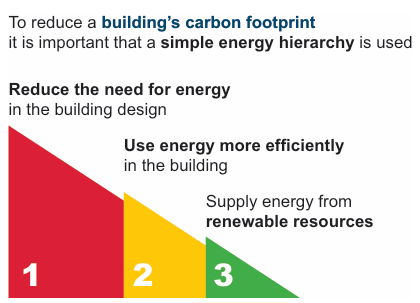
Figure 109: The energy hierarchy
Tell us what you think
For further guidance on how to submit comments, please see the Representation Guidance Note.
All comments must be received by 25 September 2026 at 5pm.