Policy H/AH: Affordable housing
Self-contained dwellings and Co-living developments
1. All major developments for housing will provide at least 40% of the new homes on site as affordable housing, unless: a different requirement is set out within the allocation policy, the development is on land within the Green Belt, or it is a Co-living development where a financial contribution for off-site provision is to be provided. This requirement applies to all residential developments of self-contained dwellings, including those for Build to Rent or specialist accommodation, and also to Co-living developments for the equivalent of 10 or more dwellings (calculated using the other communal accommodation units to dwellings ratio in the Housing Delivery Test).
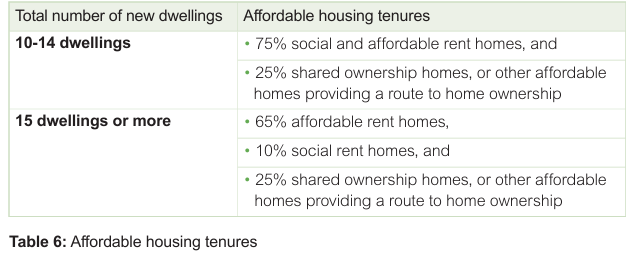
2. Within the affordable housing secured on major developments for housing (except for within Build to Rent and Co-living developments), the proportions of each affordable housing tenure will be provided as set out in Table 6. Developments providing a higher overall proportion of social and affordable rented homes, with no or a smaller proportion of shared ownership homes, will be allowed as exceptions.
3. All affordable housing secured within Build to Rent developments will be provided as Affordable Private Rent homes. Co-living developments will provide a financial contribution for the off-site provision of affordable housing that is equivalent to at least 40% of the units being affordable.
4. Any major developments for housing that are on land within the Green Belt will provide at least 50% of the new homes on the site as affordable housing, in accordance with the Golden Rules set out in national planning policy and guidance.
5. New affordable homes will be:
a. Limited to people in need of affordable housing;
b. Available in perpetuity (wherever possible);
c. Tenure blind in design so that they are indistinguishable from any other housing tenures and well-integrated with market units on the site;
d. Phased proportionally within the build out of the development to enable proper integration and timely provision; and
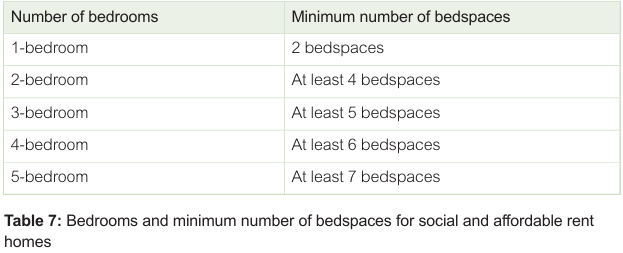
e. Designed to accommodate different family compositions, with the bedspaces per dwelling for social and affordable rent homes in line with Table 7.
6. Within major developments for housing, the new affordable homes must be dispersed in small groups or clusters that:
a. Create an even distribution of affordable housing throughout the development as a whole, and when considered in combination with neighbouring developments;
b. Contain a mix of affordable housing tenures and a mix in the number of bedrooms; and
c. Are proportionate in size to the overall size of the development, having regard to the type and location of the housing being provided.
7. The off-site provision of affordable housing or a financial contribution (commuted sum) for affordable housing will only be considered on developments of self-contained dwellings if it can be demonstrated that:
a. On-site provision would not be practicable;
b. The proposed alternative to on-site provision would be more effective in achieving a mixed and balanced community; and
c. The financial contribution for, or off-site provision of, affordable housing is at least equivalent to the increased development value resulting from affordable homes not being provided on-site, unless the applicant’s viability assessment provides compelling evidence that this would not be viable.
8. Where a larger site has been subdivided into smaller development parcels, the major developments threshold and the requirement for 40% of new homes to be affordable housing will apply to the site as a whole.
Student accommodation
9. Any developments of student bedrooms that are equivalent to 10 or more dwellings (calculated using the student accommodation bedrooms to dwellings ratio in the Housing Delivery Test) or any developments of 10 or more self-contained student units will provide a financial contribution for the off-site provision of affordable housing that is equivalent to at least 40% of the bedrooms or units being affordable. On-site delivery of affordable housing can be provided if both the Council(s) and the University of Cambridge, Anglia Ruskin University or a University of Cambridge College agree that this is appropriate.
10. An affordable housing contribution will not be sought where the proposed development of student accommodation is for the redevelopment of buildings and land owned by the University of Cambridge, Anglia Ruskin University or a University of Cambridge College, and which will continue to be owned by one of these institutions after the redevelopment.
Supporting information
9.6. Cambridge and South Cambridgeshire have been identified by the Government as areas of high affordability pressure and our evidence shows that there is an acute need for affordable housing in Greater Cambridge. The policy therefore seeks to maximise the supply of new affordable housing by requiring affordable housing on all major developments for housing that are providing self-contained dwellings, irrespective of their use class. Major developments for housing that are specifically for retirement living or other forms of specialist accommodation, Build to Rent, and Houses in Multiple Occupation, will therefore be expected to contribute towards the delivery of affordable housing. This policy does not apply to Exception Sites for Affordable Housing, as the requirements for the types and tenures of affordable housing on exception sites are included in Policy H/ES.
9.7. The policy also requires affordable units to be provided by Co-living developments. Although these developments are not providing self-contained dwellings, they are contributing towards meeting our overall housing requirement and it is therefore important that they also contribute towards meeting Greater Cambridge’s affordable housing need. Recognising that the provision of self-contained social or affordable rented housing on-site within a Co-living development is unlikely to be practical due to management issues and the shared living nature of the Co-living units, and that off-site provision will deliver affordable housing that better meets a wider range of identified local needs, a financial contribution will be sought that is equivalent in value to the on-site provision of affordable housing within other residential schemes.
9.8. Where student accommodation is delivered on buildings or land owned by the University of Cambridge, Anglia Ruskin University or a University of Cambridge College, the policy exempts such development from contributing towards affordable housing, as other types of housing would not normally be delivered in these locations. However, student accommodation brought forward on other sites could equally be suitable for other types of housing, therefore it is important that such developments are required to contribute towards meeting our affordable housing need. This would also apply where a University of Cambridge, Anglia Ruskin University or a University of Cambridge College campus is redeveloped for other types of housing. Recognising that the provision of affordable housing on-site within a development for student accommodation is unlikely to be achievable due to management issues, a financial contribution will be sought that is equivalent in value to the on-site provision of affordable housing within other residential schemes.
9.9. The thresholds at which affordable housing must be provided on any Co-living or student accommodation developments are in line with national planning policy, which allows for affordable housing to be sought on any major developments for housing i.e. 10 or more dwellings. The number of Co-living units and student bedrooms should be converted to a dwelling equivalent using the ratio for either other communal accommodation or student accommodation set out within the Housing Delivery Test rulebook. This is currently 1.9 units to one dwelling for other communal accommodation (which will be used for Co-living developments) and 2.4 bedrooms to one dwelling for student accommodation.
9.10. As set out in national planning policy and guidance, vacant buildings credit will apply to any major developments for housing on land outside of the Green Belt but will not apply to any major developments for housing on land within the Green Belt.
9.11. New affordable housing for sale or rent will be limited to those whose needs are not met by market housing, and taking account of the criteria set out in national planning policy for each of the different tenures of affordable housing. The majority of the identified need is for rented affordable housing, rather than affordable home ownership, and therefore it is important that the Councils prioritise the delivery of affordable housing for rent. The provision of genuinely affordable housing is also a priority for both Councils. The policy therefore seeks to secure an affordable housing tenure mix that will meet a wide range of housing needs and create mixed and balanced communities, providing for different types of households and household incomes.
9.12. It is important that a mix of social and affordable housing is provided, and therefore on sites providing 15 new dwellings or more, the number of new dwellings makes it possible to specifically require that within the affordable housing provided that at least one dwelling will be a social rented home. On sites of less than 15 new dwellings, this is not possible due to the number of new dwellings, however the Councils encourage the provision of social rented homes on these developments. The Councils preference in affordable homeownership tenures is for shared ownership homes, however other affordable homeownership tenures can be provided where it is demonstrated that these are necessary to meet identified needs.
9.13. The specific requirements in terms of price caps and discounts for First Homes, which are an affordable home ownership tenure, mean that they are unlikely to be a suitable affordable housing tenure on the majority of new developments in Greater Cambridge.
9.14. Where an alternative affordable housing tenure mix to that set out in Table 1 is proposed (other than for a higher overall proportion of social and affordable rented homes which is allowed as an exception), evidence will need to be provided to justify the deviation proposed. Viability will be considered as set out in national planning policy and guidance, and in accordance with Policy I/ID.
9.15. To align with the Councils’ Lettings Policies and Local Housing Allowance criteria, minimum bedspaces are set out for different numbers of bedrooms to accommodate different family compositions and to enable occupancy to be maximised.
9.16. Local Lettings Plans will be required for affordable rented and social rented homes where necessary to achieve mixed and balanced communities and/or to prioritise affordable housing for local workers or for specific groups of people. The Local Lettings Plan must be agreed by the Housing Team(s) at the Council(s) and will be published on their websites.
9.17. The Greater Cambridge Housing Strategy sets out the Councils’ priorities to tackle the housing challenges facing the area and is a material consideration in any planning decisions. The current Greater Cambridge Housing Strategy covers 2024-2029, and includes specific requirements relating to the provision of affordable housing, such as the type and tenure of affordable housing, and the clustering and distribution of affordable housing.
Tell us what you think
For further guidance on how to submit comments, please see the Representation Guidance Note.
All comments must be received by 25 September 2026 at 5pm.