Introduction
C.1. The National Planning Policy Framework (NPPF, December 2024) requires Local Plans to set out a housing requirement for designated neighbourhood areas which reflects the overall strategy for the pattern and scale of development and any relevant allocations. It also sets out that where a neighbourhood area is designated at a late stage in the strategic policy-making process, or after strategic policies have been adopted, the local planning authority should provide an indicative figure taking into account factors such as the latest evidence of local housing need, the population of the neighbourhood area, and the most recently available planning strategy of the local planning authority.
Housing requirements for designated neighbourhood areas within Greater Cambridge
C.2. The housing requirements for the 27 designated neighbourhood areas within Greater Cambridge are set out in Figure C1 below. The housing requirement for an individual neighbourhood area has been identified taking account of the overall housing requirement, the development strategy, existing supply (including actual completions in 2024/25) and the proposed additional allocations, and the population of the neighbourhood area. As actual completions in 2024/25 have already been taken into account, the housing requirements set out in Figure C1 are for 2025-2045.
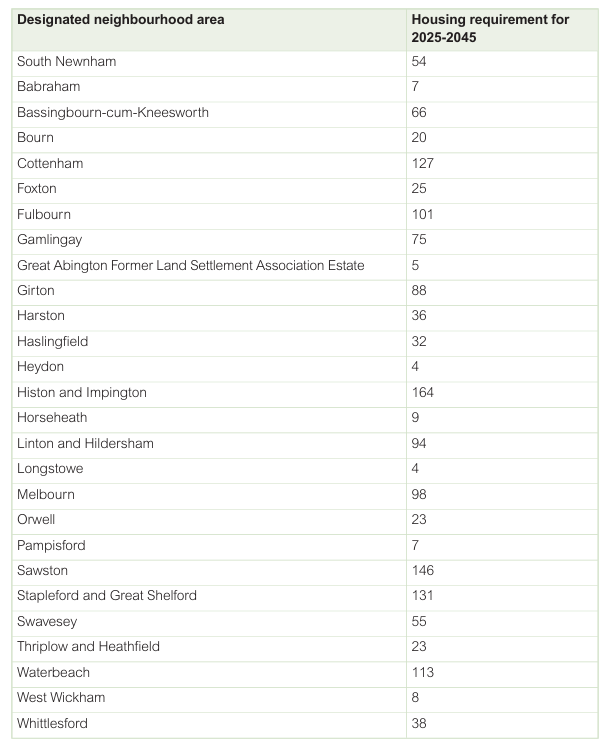
Figure C1: Housing requirements for designated neighbourhood areas within Greater Cambridge
*Figure replaced during consultation to correct version (as shown in Proposed Submission Local Plan PDF).
Methodology for calculating the housing requirement of a new or amended designated neighbourhood area
C.3. A housing requirement for a new or amended neighbourhood area will be calculated based on:
- The overall housing requirement in the Local Plan: 48,069 dwellings between 2024 and 2045;
- The population of the neighbourhood area: using the Census 2021 and its proportion of the Greater Cambridge population of 307,789; and
- The most recent planning strategy: consisting of the development strategy and housing trajectory in the Local Plan that together demonstrate how the overall housing requirement will be met largely through actual completions in 2024/25 and allocations in sustainable locations, therefore leaving a remaining housing requirement of 6,183 dwellings to be met from other sources or through windfall sites.
C.4. As actual completions in 2024/25 have already been taken into account, the housing requirement will be calculated for 2025-2045 by proportionally splitting the remaining housing requirement on the basis of the neighbourhood area’s proportion of the Greater Cambridge population.
C.5. For any neighbourhood areas that do not exactly match with a parish boundary or Census output area(s) boundary, a best fit with the available boundary options will be used to calculate the population of the designated neighbourhood area.
C.6. For example, if a new neighbourhood area is designated for the whole of a parish with a population of 1,275 in the Census 2021. This parish has 0.41% of the Greater Cambridge population, and therefore would have a housing requirement of 0.41% of the remaining housing requirement of 6,183 dwellings, therefore 25 dwellings.
Tell us what you think
For further guidance on how to submit comments, please see the Representation Guidance Note.
All comments must be received by 25 September 2026 at 5pm.