Policy BG/EO: Providing and enhancing open spaces
1. New development must address the open space needs it generates, which will be secured through a mix of on-site provision and/or financial contributions for off-site open space provision, enhancement and/or management.
2. For green space and/or, open space, play and food growing space the scale and type of on-site provision, and any required financial contribution to off-site provision, will be determined in agreement with the Local Planning Authority, having regard to:
- Site-specific constraints and opportunities, including the ability for the site to provide effective space/s for each typology at a scale that would be effective; and
- Existing local provision and identified gaps in the relevant space type, including for accessible greenspace when assessed against the size-proximity criteria (as defined in Figure 111).
Accessible Green and Open Space Standards
3. All major developments that are predominantly residentially led must demonstrate total provision of accessible greenspace equivalent to 7.0 hectares per 1,000 population, and within this total, deliver a minimum on-site accessible greenspace provision that:
- Is equivalent to 3.0 hectares per 1,000 of the population, unless the calculated on-site quantum falls below a functional minimum parcel size of 0.5 hectares. In such cases, the shortfall must be secured off-site; and
- Ensures access for all residences within the development to at least one appropriate tier of greenspace within the size-proximity criteria (as defined in Figure 111).
4. All commercial developments for 2,000 square metres or more (Gross Internal Area) within Use Classes E(g)(i), E(g)(ii), as well as sui generis uses where the proposal comprises a research, innovation or institutional campus, must:
- Demonstrate open space provision equivalent to 2.0 hectares of open space per 1,000 employees and /or;
- Where justified and agreed with the LPA, make this provision off-site via financial contributions, with a focus on contributions to local greenspaces likely to be impacted by visits by on-site employees following occupation.
5. All green and/or open space must be designed to be welcoming and accessible meeting the needs of all users, with habitats and infrastructure appropriate to the local character and typology of greenspace. Green and/or open space design and management planning must have regard to best practice guidance as defined by the Green Flag Award criteria.
6. The residual accessible green and/or open space requirement not provided on-site will be secured as off-site provision and / or financial contributions to the delivery and/or management of accessible green and/or open space. Offsite contributions should be provided towards greenspaces that are within the relevant access catchments for the development as set out in Figure 111, and where possible, support the objectives of the Green Infrastructure Strategic Initiatives identified in the Greater Cambridge Green Infrastructure Opportunity Mapping Recommendations Report (2021) and green infrastructure schemes identified within the Greater Cambridge Local Plan Infrastructure Delivery Plan (or successor document).
7. Accessible Green Space provision for development proposals that are located within a zone of potential risk for a publicly accessible Site of Special Scientific Interest (SSSI) that is sensitive to the effects of recreational pressure, must be informed by Natural England guidance and delivered alongside early phases of development. For such development proposals:
- On-site Accessible Green Space provision must include areas designed to absorb significant proportions of the day-to-day recreational needs of residents; and
- Any off-site contributions should be prioritised towards greenspaces that are located and designed in such a way that mitigates the impacts on the SSSI/s that are affected by that development.
Play and Youth Space
8. All major developments that are predominantly residentially-led must demonstrate provision of play and youth space equivalent to 0.6 ha per 1,000 population. This should include at least 0.25 ha per 1,000 population of equipped play and at least 0.3 ha per 1,000 population of informal play provision.
9. Play space provision must be designed prioritising quality, inclusivity, and integration into the wider green infrastructure network in line with national best practice as defined by Fields in Trust, Play England and Active Travel England.
10. Any shortfall in the provision of play and youth space onsite must provide a financial contribution towards the provision of play and youth space offsite.
Food growing space
11. All major developments that are predominantly residentialled must demonstrate provision of food growing space equivalent to 0.4 ha per 1,000 population.
12. Food growing spaces should be provided on-site by default. The design, approach to on or off-site provision, and management of food growing spaces must be informed by the Food Growing Study or successor document.
13. Any shortfall in the provision of food growing spaces on-site must provide a financial contribution towards the provision of food growing space offsite.
GI Operation and Maintenance Plan
14. All green space, open space, play and/or food growing space must have an adopted management plan (GI Operation and Maintenance Plan), outlining how the space will be managed over a 30-year period, and the funding and stewardship arrangement for implementing the management plan, secured via condition.
Supporting information
5.85. Open spaces, regardless of ownership, are a key aspect for high-quality urban and rural environments, often defining the character of an area. These spaces provide places for relaxation and socialisation, promote healthier lifestyles through opportunities for sport and informal play, and can deliver wider benefits for nature by creating habitat, contribute to cooling and play a key role in adapting to climate change. The character of Greater Cambridge is significantly shaped by its green spaces, trees, and landscape features, including the River Cam.
5.86. There is a recognised under-provision of accessible greenspace in Greater Cambridge. This is particularly so in relation to strategic-scale open spaces, that is district and sub-regional spaces of over 100 hectares. The deficiency of these spaces is also placing increased pressure on local biodiversity sites, especially where these include areas of sensitive habitats.
5.87. The Councils have developed evidence to inform the standards for the quantity, quality and accessibility of greenspace provision required from development, seeking to implement Natural England’s Green Infrastructure Framework (NEGIF) at a local level.
5.88. Residential development will be expected to contribute to providing publicly accessible green space, to ensure growth in Greater Cambridge leads to no net loss in per capita access to publicly accessible green space. Accessible greenspace comprises amenity green space, Informal open space, Urban destination parks and gardens, Urban neighbourhood parks, Country Parks and Natural/Semi-Natural Green Space. Commercial development must contribute to accessible green and open space to relieve recreational pressure from workers using nearby accessible greenspace. The definition of Accessible Greenspace is set out in the Glossary and the typologies for the Accessible Greenspace are set out in the Greater Cambridge Green Infrastructure and Open Spaces Standards Framework Final Report (June 2026). Population will be calculated using the latest Council household multipliers for new development as set out in the Strategy Topic Paper.
5.89. Residential developments are expected to contribute to play space. Play spaces should be well-designed, multifunctional and creative environments that provide high play value and contribute to the wider landscape. Provision should include informal and nature-based play, be accessible via safe active travel routes, and feel welcoming and safe for girls and young women, children with disabilities, and teenagers. Design proposals should ensure natural surveillance, varied and age-appropriate opportunities, and long-term management and maintenance.
5.90. To maximise opportunities for the working population to access green spaces for gathering, relaxation and informal recreation, on-site open space provision will be sought for development proposals for employment uses with E(g)(i), E(g)(ii), or E(g)(iii) for 2,000 square metres or more Gross Internal Area. Unlike residential developments, these open spaces can include “civic spaces” which provide for the health and wellbeing needs of on-site employees. The number of employees will be calculated using the Councils latest job density calculations. Where appropriate, any provision should be made available to the wider community outside of working hours.
5.91. Natural England's Accessible Greenspace Standard identify required provision of different scales of green space at different distances from development. Development should demonstrate how provision of on site open spaces responds to gaps in existing provision in the locality when considered against these standards. The Greater Cambridge Green Infrastructure Strategy includes analysis of Greater Cambridge’s existing provision against the NEGIF size and proximity standards.
5.92. To ensure that any on-site green and open space provision is of a high quality, development proposals will be expected to demonstrate that any provision is of a high quality with regard to best practice guidance. This can be demonstrated through the submission of a standalone document or as part of a design and access statement.
5.93. Major development proposals must be accompanied by a Green Infrastructure Plan (see Policy BG/GI), demonstrating how the proposal meets the green and/or open space standards set out in this policy as well as management and maintenance arrangements.
5.94. Financial contributions for off-site provision will be calculated using the Greater Cambridge Green Infrastructure Strategy, and Greater Cambridge Play Strategy. Contributions towards off-site facilities will be directed to enhancing existing local green space and/or delivery of schemes that support the delivery of the objectives of Greater Cambridge Strategic Green Infrastructure Initiatives identified in Policy BG/GI. Contributions will also be directed towards management of green space where appropriate.
5.95. To mitigate further recreational impacts on sensitive SSSIs arising from development, Accessible Green Space provision for development proposals that are located within a zone of potential risk for a publicly accessible Site of Special Scientific Interest (SSSI) that is sensitive to the effects of recreational pressure, must be informed by Natural England’s guidance for applications within the Cambridgeshire SSSIs Recreational Pressure Impact Risk Zone (IRZ), or successor document.
5.96. Food growing is increasingly less about growing food to feed a family and more about a shared experience that enhances health and wellbeing and provides a space where biodiversity can thrive. Generally, to provide a range of food growing opportunities, a mix of allotments and community growing spaces should be provided subject to appropriate stewardship arrangements. Any shortfall in meeting the Food Growing Standard requires a financial contribution to contribute to other food growing opportunities. New food growing provision will also include financial contributions towards their management and maintenance.
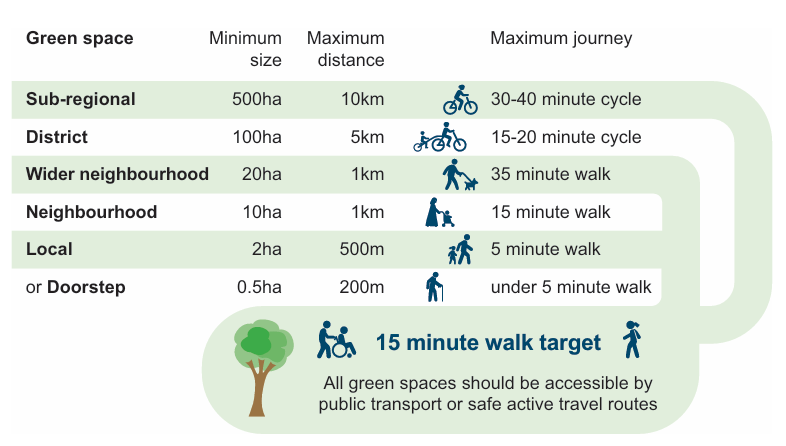
Figure 111: Natural England’s Green Infrastructure Standards: Size and Proximity Standards from the Natural England Green Infrastructure Framework.
Tell us what you think
For further guidance on how to submit comments, please see the Representation Guidance Note.
All comments must be received by 25 September 2026 at 5pm.