Policy CC/NZ: Net zero carbon new buildings
1. New development (with the exception of householder applications) must achieve net zero operational emissions by following a hierarchical approach of reducing heat and power demand then supplying all energy demand through onsite energy generation. Through the submission of an Energy Statement incorporating energy performance calculations undertaken using a methodology capable of providing accurate predictions of total in-use energy (such as CIBSE TM54 or the Passivhaus Planning Package), proposed new development will demonstrate the following hierarchical approach:
Net Zero Carbon buildings – operational emissions
Part A: Space heating
2. Achieve a specific space heating demand as follows:
a. All new dwellings must achieve a space heating demand of 15 – 20 kilowatt-hours (kWh) per metre squared Gross Internal Area (GIA) per year.
b. All new non-domestic buildings must achieve a space heating demand of 15 – 20 kWh per metre squared GIA per year.
3. All heating should be provided through low carbon fuels (not fossil fuels).
4. No new developments should be connected to the gas grid.
Part B: Total Energy Use Intensity (EUI)
5. EUI targets are achieved as per building type (set out in kWh per metre squared GIA per year) as follows:
a. All dwellings must achieve an EUI of no more than 35 kWh per metre squared per year.
b. Non-domestic buildings must achieve the following EUI where technically feasible and viable by building type:
i. Offices: Equivalent to the UK Net Zero Carbon Buildings Standard 2030 targets (and sub-typologies where available).
ii. Schools: 65 kWh per metre squared per year.
iii. Multi-residential (e.g. student accommodation): Equivalent to the UK Net Zero Carbon Buildings Standard 2030 targets (and sub-typologies where available).
iv. Retail: Equivalent to the UK Net Zero Carbon Buildings Standard 2030 targets (and sub-typologies where available).
v. Leisure: Equivalent to the UK Net Zero Carbon Buildings Standard 2030 targets (and sub-typologies where available).
vi. Research facility: Equivalent to the UK Net Zero Carbon Buildings Standard 2030 targets (and sub-typologies where available).
vii. Higher education teaching facilities: Equivalent to the UK Net Zero Carbon Buildings Standard 2030 targets (and sub-typologies where available).
viii. Light industrial uses: Equivalent to the UK Net Zero Carbon Buildings Standard 2030 targets (and sub-typologies where available).
ix. Hotel: Equivalent to the UK Net Zero Carbon Buildings Standard 2030 targets (and sub-typologies where available).
x. All other non-residential uses: Equivalent to the UK Net Zero Carbon Buildings Standard 2030 targets (and sub-typologies where available).
Part C: Energy performance/Onsite Renewable Energy
6. Proposals must seek to maximise opportunities to generate on-site renewable energy and facilitate flexibility to enable the development, where possible, to achieve all energy demands through onsite energy generation.
7. Proposals that include battery storage to maximise the use of onsite energy generation will also be supported.
Part D: Energy Offsetting and Assured Energy Performance
8. Where economic viability or technical constraints prevent policy compliance, proposals must first and foremost strive to meet the space heating and total energy consumption thresholds. Proposals must then benefit as much as possible from onsite renewable energy generation. Energy offsetting should only be used as a last resort (for example where there is limited roof space to generate renewable energy). Offsetting payments must be used to invest in additional renewable energy generation to ensure that net zero carbon buildings are delivered. These offsets will primarily be delivered via developer contributions to a fund which would be ring-fenced for use only to deliver local projects that would deliver the required shortfall in renewable energy. In some cases, it may be acceptable for the developer to conduct direct delivery of these local energy offsetting projects rather than provide a financial contribution, subject to Council approval of the proposed projects based on meeting criteria around their effectiveness, suitability and guaranteed delivery timescales.
9. All applicable developments must demonstrate use of an assured performance method in order to ensure that the buildings’ operational energy performance reflects design intentions and addresses the performance gap, which may be secured via condition.
10. For reporting purposes, all development over 50 homes and 5,000 square metres GIA of employment floorspace should complete in-use energy monitoring.
Net Zero Carbon Buildings – construction and embodied carbon
11. All major development must demonstrate, through the Sustainability Statement, what measures have been taken to reduce embodied carbon content as far as possible through lean design, choice of materials and material efficiency. Proposals for large scale new-build developments (a minimum of 100 homes or a minimum of 10,000 square metres GIA of non-residential floorspace) must submit a Whole Life Carbon Assessment using a nationally recognised whole life carbon assessment tool and demonstrate actions to reduce up-front embodied carbon emissions (modules A1-A5 of the RICS methodology – see Figure 107). This should include reducing emissions associated with construction plant.
Supporting information
4.15. The UK has a legally binding requirement to achieve net zero carbon by 2050. In June 2021, Government adopted its sixth carbon budget, which forms part of the route map to achieve net zero carbon by 2050 and requires a 63% reduction in emissions from 2019 to 2035 (78% relative to 1990).
4.16. Our Net Zero Carbon Study (2021) advises that new buildings need to be built to net zero carbon standards as soon as possible for Greater Cambridge to play its part in meeting the UK’s carbon budgets. By considering the three elements of space heating demand, energy use intensity and onsite renewable energy together, the policy seeks to deliver low energy consumption, energy efficient, net zero energy buildings.
4.17. This policy deals with all of the carbon associated with new buildings. This includes carbon associated with the energy needed to power homes and commercial buildings, and the carbon associated with the processes and materials used to construct those buildings, known as embodied carbon, to promote lean design and the implementation of circular economy principles.
4.18. The policy also seeks to address the performance gap between designed performance and as built performance through the use of an Assured Performance Process. These are all elements that are not fully covered in other regulations such as Building Regulations. The policy is underpinned by detailed technical and viability evidence, demonstrating that the approach is feasible and viable.
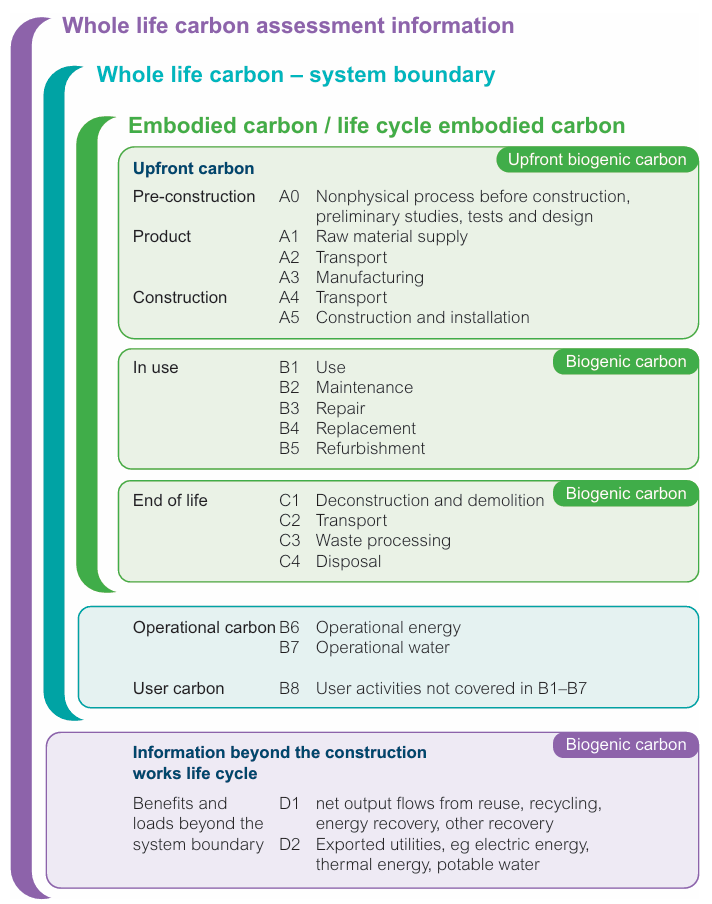
Figure 107: Building and infrastructure life cycle stages and information modules (source: Whole life carbon assessment for the built environment. 2nd edition, September 2023, Version 3, August 2024, RICS).
4.19. Applicants will need to take a design approach that follows the energy hierarchy to meet these energy use requirements. Making sustainable design decisions early on, such as considering the most effective orientation, optimising the form factor of a building and taking a fabric first approach will help applicants meet space heating demand and EUI policy requirements more easily. Following this, applicants will need to supply energy efficiently, and the policy provides flexibility by not specifying how this should be achieved.
4.20. In the majority of cases, it is likely that heat pumps will be chosen, and the technical work underpinning the policy was undertaken on the basis of the use of air source heat pumps. Policy CC/RE and the Policies Map also identify areas for district heating (from zero emission sources), and applicants may wish to consider connection to such networks. Lastly, the policy requires onsite renewable energy generation to match the total energy demand, to achieve an on-site net zero energy balance. Again, flexibility is allowed for in terms of choice of technologies, but it is likely that integration of rooftop solar PV will be the most likely choice for new developments.
4.21. In some cases, schemes delivered to specific standards will be deemed to comply with elements of the policy. Table 5 below sets out which specific standards will be deemed as providing compliance and the submission requirements. Additional standards may be considered as providing a route to compliance where these deliver performance in line with the metrics contained within Policy CC/NZ. This should be discussed with officers as part of pre-application discussions.
4.22. There may be exceptional circumstances where policy requirements cannot be met in full, for example where there is insufficient roof space for renewable energy generation. In these cases, the priority should be meeting the Space Heating Demand and EUI requirements of the policy, followed by implementing as much renewable energy generation as possible. The remaining energy balance would then be offset via payment into a fund to be used for delivery of renewable energy elsewhere within Greater Cambridge.
4.23. Energy offsetting will primarily be delivered via developer contributions to a fund which would be ring-fenced for use only to deliver local projects that would deliver the required shortfall in renewable energy. In some cases, it may be acceptable for the developer to conduct direct delivery of these local energy offsetting projects rather than provide a financial contribution, subject to Council approval of the proposed projects based on meeting criteria around their effectiveness, suitability and guaranteed delivery timescales.
4.24. To reduce carbon emissions from construction and embodied carbon, applicants are encouraged to align their proposals with the relevant upfront embodied carbon targets set out in the UK Zero Carbon Buildings Standard, with reference to the targets relevant at the time of application.
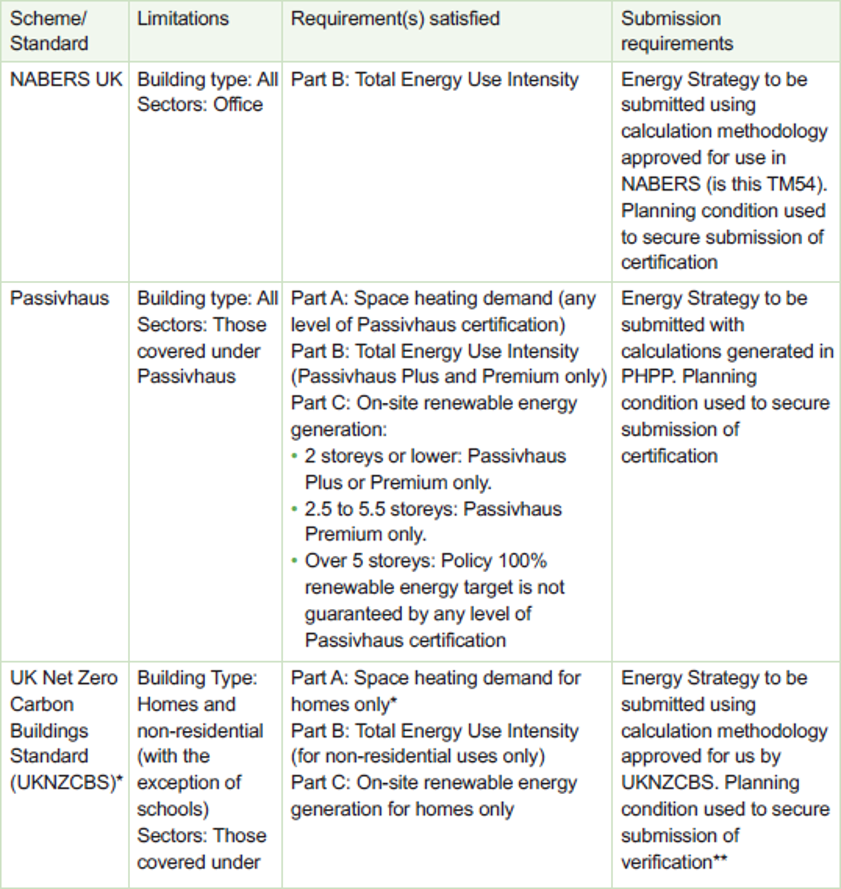
Table 5: Other standards deemed to comply with elements of Policy CC/NZ (note this can apply to all scales of development).
* At present the UKNZCBS does not set a space heating demand for non-residential buildings. This may change in future versions and if this matches the space heating demand referenced in Policy CC/NZ, this can then be used for deemed compliance.
** UKNZBCS only gives full verification based on at least 1 year of energy use data. This may be impractical to secure through condition. However, UKNZCBS also offers a “post-completion on-track” verification consisting of a set of checks showing that a completed building is capable of performing to the relevant UKNZCBS targets. This “post-completion on-track” verification would be the subject of the planning condition where UKNZCBS is used as the route to policy compliance.
Tell us what you think
For further guidance on how to submit comments, please see the Representation Guidance Note.
All comments must be received by 25 September 2026 at 5pm.