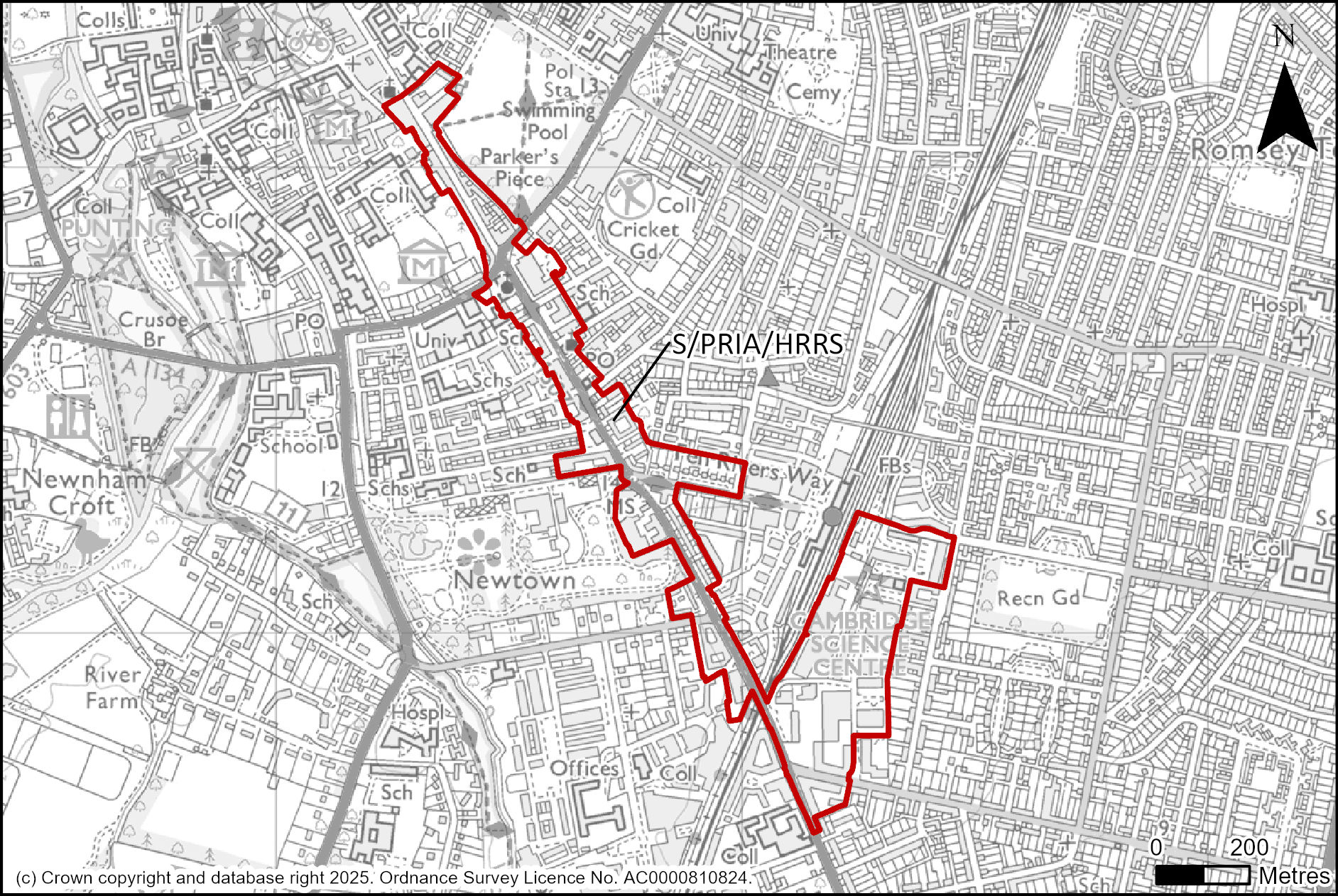
1. Development proposals within the Hills Road and Regent Street Corridor area will be supported if they:
a. deliver coordinated streetscape and public realm improvements that:
i. emphasise ‘place making’ over vehicle movement, including at junctions, using tighter geometry and radii, to reduce approach speeds and to reclaim areas for additional public space;
2. re-establish historic routes and create clear gateways/entry points into existing residential neighbourhoods;
3. create a more comfortable and simplified pedestrian environment through provision of more generous pavements and street trees, removal of pedestrian guardrails and unnecessary signage, and introduction of more direct crossings that respond to key desire lines; and
4. use an appropriate and durable palette of materials.
5. Allocated sites with the potential to deliver new development include Betjeman House, Hills Road (Site Ref. S/C/BJH), Cambridge Junction and Cambridge Leisure, Hills Road (Site Ref. S/C/CJ) and Clifton Road Area (Site Ref. S/C/CLT).
6. The following key projects will be delivered through development proposals and in accordance with criteria 1 (a-d):
a. Regent Street – reallocation of space for wider pavements to better cope with pedestrian flows, reduce street clutter and provide improved cycle parking facilities;
b. Hyde Park Corner – improvement of the setting of the Our Lady of the English Martyrs Church and increase pavement widths in front of the terrace opposite. Simplify the pedestrian and cyclist user experiences through more direct crossings and investigate the potential for single stage crossings;
c. Hills Road / Cherry Hinton Road / Cambridge Leisure Park District Centre – reconnection of both sides of the street and improvement of the pedestrian user experience through removing barriers and obstacles. Traffic management and the reallocation of space will help to reduce vehicle speeds and highlight the revitalised ‘hub’ of Hills Road;
d. Cambridge Leisure Park – creation of a high-quality connection into the site, by upgrading the existing link south of the station across Hills Road Bridge; proposals should ensure they are integrated with later stages of the Chisholm project and other active travel proposals;
e. Cherry Hinton Road junction – revision of the approach to traffic management and highway engineering to create a quality connection between the new developments on all sides of the junction through to Hills Road and Cambridge Leisure Park;
f. Lensfield Road junction – simplification and rationalisation of the layouts of the two junctions remove the bottleneck that causes traffic to back along Gonville Place. Improve the quality of the public realm and connectivity for pedestrians and cyclists.
Supporting information
The streets and junctions within the Public Realm Improvement Area can often be congested with traffic with pedestrians experiencing a poor-quality public realm. The implementation of this policy will create an improved, high-quality link connecting the city centre to the railway station area. It will improve connectivity and character in this part of Cambridge by supporting and prioritising walking and cycling and creating a better sense of place. When linked, the key projects identified within the policy will create a high-quality pedestrian and cycle route from the station into the city centre.
Redevelopment of sites within the area will help improve the environmental quality of the whole area, creating a more inclusive public realm and promoting ‘place making’. These improvements will promote the character and distinctiveness of Hills Road and Regent Street to create streets that will foster a sense of community and provide attractive places to live in, work in and travel through. Where redevelopment occurs within the local centre, opportunities should be taken to provide a mix of uses, including residential uses on upper floors.
Tell us what you think
We will consider all comments while developing the next version of the Local Plan.
All comments must be received by 30 January 2026 at 5pm.