What this policy does
This policy aims to ensure that development proposals that may affect heritage assets, or their settings are carefully considered. It also supports the conservation and enhancement of the historic environment through the Greater Cambridge Historic Environment Strategy detailed within the policy, ensuring that new development respects and integrates with the historic context of the area.
Policy GP/HE: Historic environment
1. All development proposals that have the potential to impact heritage assets or their setting must be supported by a Heritage Impact Assessment. The level of detail contained within the Heritage Impact Assessment should be proportionate to the proposed development and the number of assets affected.
2. The Local Planning Authorities will balance the need for development with the conservation, enhancement and enjoyment of the historic environment through a positive strategy to ensure that:
a. Proposals affecting the historic environment consider the wider social, economic, cultural and environmental benefits of conserving heritage assets, taking into account the positive contribution that conserving heritage assets can make to the sustainability of communities;
b. New development conserves and, where appropriate, enhances the special character and distinctiveness of Greater Cambridge. Proposals must respect the character, setting and nature of any heritage asset, with the positive contribution made by the historic environment taken into consideration and used to inform design;
c. Heritage assets are sustained in viable uses that are compatible with their significance.
Supporting information
Greater Cambridge boasts a rich and diverse historic environment, formed of both designated and non-designated assets. This includes a high number of nationally listed buildings, conservation areas, registered parks and gardens, scheduled monuments, and other heritage assets of local importance. Much of this heritage is visible in the distinctive historic landscapes shaped by agricultural, academic, residential and commercial development, while other elements of the historic environment are more intangible.
Greater Cambridge’s unique blend of historic towns, villages, and hamlets set within the countryside contribute to the local character and sense of place, whilst Cambridge, which has a varied architectural heritage, from the internationally recognised grandeur of King’s College Chapel to the more modest vernacular buildings reminiscent of an East Anglian market town. Greater Cambridge’s historic environment is an important resource, bringing social, cultural, economic and environmental benefits to the community, adding to the quality life and wellbeing of residents and visitors. Important visitor attractions with historic merit include Wimpole Hall, Denny Abbey and the Imperial War Museum, Duxford and Cambridge University’s Botanic Garden and Fitzwilliam Museum and colleges. Together, these features of the historic environment form an irreplaceable cultural resource that enriches the character and cultural identity of Greater Cambridge.
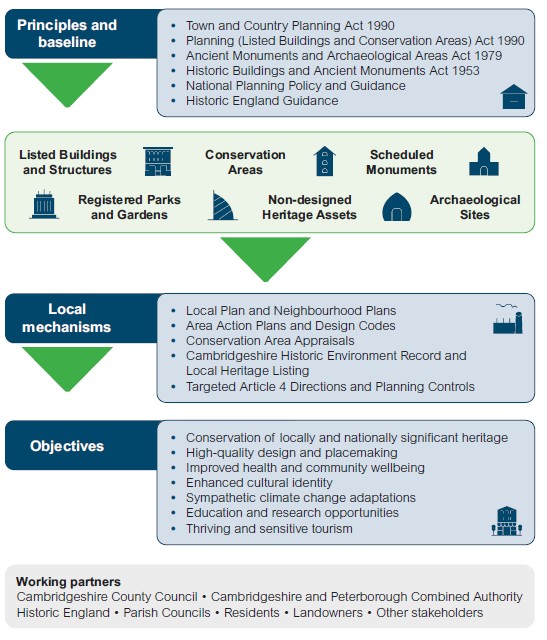
Heritage is an essential component of plan-making. A full understanding of the historic environment, including traditional materials and construction methods used in vernacular buildings, is needed to inform plans, identify opportunities for conservation and enhancement, and reinforce a local sense of place. Given the rich tapestry of Greater Cambridge’s historic and natural environment and the strategic objectives of this Local Plan, the planning strategy for Greater Cambridge’s historic environment requires a multi-layered approach that includes a number of interrelated actors, initiatives and local planning instruments (see Figure 133 overleaf). The components of the Greater Cambridge Historic Environment Strategy will be added to and updated as necessary and provide tools to realise the ongoing management of the area’s heritage assets. Planning decisions will be made having regard to the content of the relevant components of this Historic Environment Strategy.
The Councils will work with communities, partner organisations, and developers to conserve and enhance the historic environment wherever possible, and address development challenges in a balanced and sympathetic way. Pressures from development need to be carefully considered in order to ensure they do not detrimentally impact Greater Cambridge’s historic environment, particularly South Cambridgeshire’s special rural character and the nationally significant buildings and green spaces in the centre of Cambridge.
The Local Planning Authority will actively seek the protection of Greater Cambridge’s designated and non-designated heritage assets. New development must respect the character, setting and nature of any heritage assets that might be affected by the proposed development. As part of the strategic approach to the Historic Environment, the Local Planning Authorities will require applications to include Heritage Impact Assessments where a proposal would impact heritage assets to ensure that the effective use of available local planning mechanisms. Heritage Impact Assessments are useful tools that help developers and decision-makers to understand the importance of heritage assets that might be impacted by a proposal.
The details included within a Heritage Impact Assessment will vary depending on the nature and scale of the development, but they typically include:
- a description of the significance of any heritage assets affected, including any contribution made by their setting;
- a proportionate assessment of the potential impact that development may have on the heritage asset, their historic importance, and their setting;
- justification for works that seek to alter heritage assets and the wider historic environment;
- information on any sources that have been consulted to prepare the assessment, such as Conservation Area Appraisals and the Cambridgeshire Historic Environment Record;
- the expertise and experience of the person(s) conducting the Heritage Impact Assessment.
Supporting topic paper and evidence studies
- Greater Cambridge Local Plan: Topic Paper 5: Great Places
- Greater Cambridge Strategic Heritage Impact Assessment (2021)
Tell us what you think
We will consider all comments while developing the next version of the Local Plan.
All comments must be received by 30 January 2026 at 5pm.