What this policy does
The West Cambridge site is a major hub for the University of Cambridge and research institutions, featuring academic departments, national labs, and commercial research facilities focused on physical sciences, engineering, and computer science. The site will continue to evolve over the lifetime of this local plan. The policy seeks to ensure that future proposals contribute to the creation of a vibrant innovation district, with services, facilities and uses to complement the employment and research facilities.
Policy S/WC: West Cambridge
1. An extension of Cambridge of up to 370,000 square metres of academic floorspace (Use Class F), commercial research and development floorspace (Use Class E(g)(ii) and sui generis research uses) of which no more than 170,000 square metres will be for commercial use (Use Classe E(g)(ii)) and other supporting development including: nursery (Use Class E(f)), 4,000 square metres of retail/food and drink, between 3,000 square metres and 4,100 square metres of assembly and leisure, energy and data centre and residential to support vibrancy of the development, open spaces, landscape areas and infrastructure works.
Vision and identity
2. The West Cambridge site is a major hub for the University of Cambridge and research institutions. It provides an opportunity to support the needs of the city and the university, creating a vibrant innovation urban quarter which is highly connected to the city by active travel and public transport, helping to provide space for research and the sharing and implementation of ideas.
3. The site is inherently linked to the University's major development site at Eddington, to the north, which is primarily for university key workers and students but also providing homes for Cambridge generally and is also expected to provide mid-tech and other employment uses. It is critical to the success of both sites, and the city more broadly, that these two sites are planned in a holistic and comprehensive manner.
4. The West Cambridge site is to be well connected to the surrounding area, with the Cambourne to Cambridge public transport corridor to be routed along Charles Babbage Road (if permitted under the Transport and Works Order Act), and also benefits from high quality footpaths and cycleways, including links across Madingley Road to Eddington.
5. The site lies on the edge of the Green Belt and will respect this sensitive location by softening its impact, with substantial landscaping and well-considered building heights on its edges.
Uses
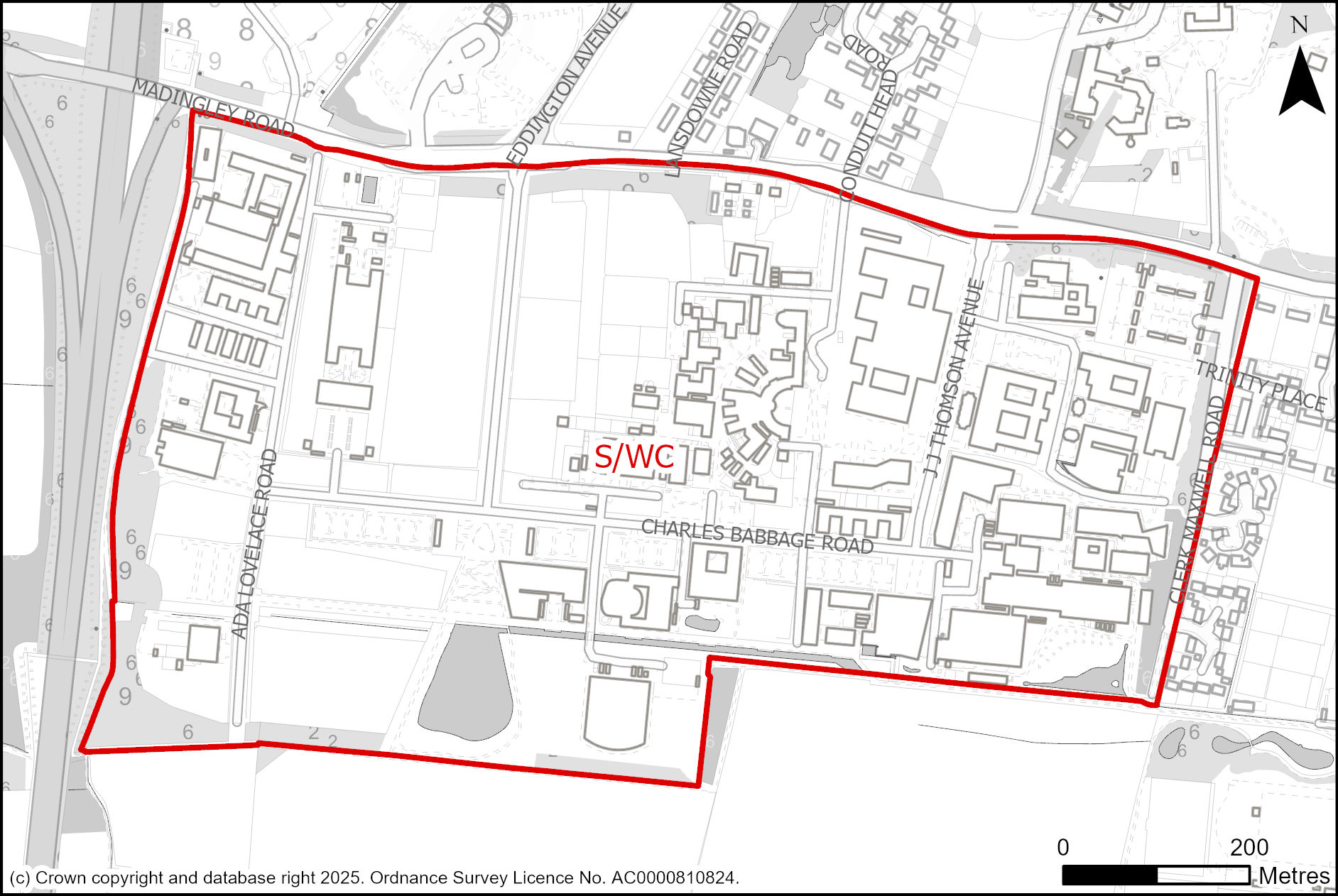
1. West Cambridge is allocated for mixed-use development as shown on the Policies Map and indicative Spatial Framework up to 383,300m2, comprising:
a. Up to 370,000 square metres of academic floorspace (Use Class F1(a);
b. Commercial research and development floorspace (Use Class E(g)(ii) and sui generis research uses) of which:
i. no more than 170,000 square metres will be for commercial use; and
ii. development for commercial research will be required to demonstrate it will support knowledge transfer and/or open innovation in respect of F1(a) higher educational uses, associated sui generis research establishments, academic research institutes and/or other commercial research and development uses already at West Cambridge;
c. Up to 2,500 square metres nursery floorspace (Use Class E(f));
d. Up to 4,000 square metres retail/food and drink floorspace (Use Classes E(a), E(b) F2(a);
e. Up to 4,100 square metres and not less than 3,000 square metres for assembly and leisure floorspace;
f. Up to 5,700 square metres of sui generis uses, including an energy centre and data centre; and
g. Associated infrastructure including roads, cycle and pedestrian routes, parking, drainage, open spaces, landscaping and earthworks.
2. Further densification, resulting in floorspace over and above the allocated development quantum, will be supported subject to:
a. Preparation and submission of a revised masterplan, agreed through a revised outline planning permission, which:
i. takes an integrated and comprehensive approach to the provision and distribution of the uses;
ii. considers opportunities to incorporate residential uses for people working on- site, in addition to the existing allocated uses, and additional appropriate supporting facilities and amenities;
iii. includes further phases of the sports centre.
b. Agreement of appropriate development phasing through the outline planning permission, as the need is proven; and
c. Testing and agreement of the precise quantum of new floorspace through an outline planning application for the site.
The development of West Cambridge must do the following:
Context
3. Respect the important adjacent Green Belt setting to the south and west, and neighbouring residential uses and views of the city from the west, by providing substantial landscaping (as shown on the parameter plans for the outline planning permission approved under planning reference 16/1134/OUT).
4. Informed by a Landscape Visual Impact Appraisal and Heritage Impact Assessment, secure design-based mitigation, including appropriate massing and careful consideration of building heights, in response to the site’s heritage, townscape and landscape context, including:
a. Preserving the setting of the Grade II* Listed Schlumberger Gould Research Centre, including open green spaces to the east and west;
b. Protecting the setting of the West Cambridge and Conduit Head Road conservation areas;
c. Considering any impacts on Strategic Viewpoint B: Coton Footpath over the M11.
Built form
5. Any applications for development must be in accordance with the Spatial Framework diagram and also accord with:
a. Any approved design code / design guidelines for the site; and
b. The Amenities Delivery Strategy (approved under planning reference 16/1134/OUT).
6. Any additional densification of the site which goes beyond the existing outline planning approval will require submission of a revised design code and/or design guidelines document.
Nature
7. Any applications for development must be in accordance with:
a. The Woodland Management Plan (approved under planning permission reference 16/1134/OUT).
Movement
8. Any additional densification of the site which goes beyond the existing outline planning approval will require:
a. Submission of a comprehensive transport strategy, showing how development will contribute to increasing sustainable modes of transport and improve links to other employment, amenity, and educational sites, including those located at Eddington;
b. Submission of an up to date Transport Assessment setting out development trips and proposed mitigation for the remainder of the development floorspace;
c. Contributions towards strategic transport infrastructure through a Section 106 agreement, including a new traffic signal controlled restricted movement (right in left out), access junction onto Madingley Road at the western end of the site.
Resource
9. Utilise innovative approaches to water management on-site, including sustainable drainage systems (SuDS), water reuse and natural systems and landscaped solutions as appropriate, to help address flood risk, including surface water,
Lifespan
10. The applicant must identify a proposed approach to the long-term management, maintenance and stewardship of infrastructure, services, and facilities not provided by statutory undertakers, including:
a. Car and cycle parking;
b. Sustainable surface water drainage;
c. Landscaping and open spaces;
d. Community buildings and indoor and outdoor sports facilities; and
e. Unadopted roads and parking enforcement.
Supporting information
West Cambridge plays an important academic and research role for the University of Cambridge. It forms part of the University’s long term strategy to decant some existing facilities away from the Historic Core of the city where space is more limited and the historic environment is more sensitive.
The site should achieve a mix and density of development that supports a compact, walkable, and sustainable urban form that promotes active travel and public transport use. The site already benefits from excellent active travel connections into the City Centre, whilst the Madingley Park and Ride and proposed Cambourne to Cambridge Busway support the public transport network in this area. Given the sites sustainable location and excellent connectivity, the policy identifies that the site is a suitable location for further development.
To achieve a vibrant place that is provides more than just buildings for people to work and study, the site must include residential development as well as a range of services and facilities to support those that will live, work and visit the site, building on excellent placemaking outcomes of developments such as The West Hub. The uplift in the number of dwellings and additional mid-tech use will support this but needs to be balanced with the need to respect and enhance the local landscape, townscape and heritage, informed by various evidence base documents.
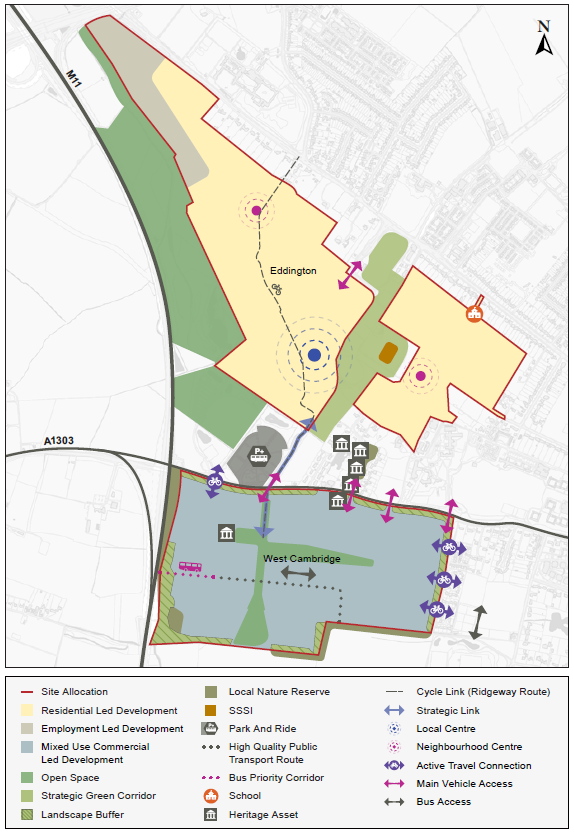
The site must also be planned for in combination with S/NWC Eddington as part of an Innovation District approach, which brings together homes, jobs, academia and other services and facilities. To achieve this aspiration, high standards of pedestrian and cycling connectivity are vital.
The site abuts the Green Belt, and substantial landscaping is required to soften the transition. There is also a requirement to consider heritage assets which may be affected by the development. A Grade II Listed Building, the Schlumberger Gould Research Centre, occupies a small part of the site, and the policy requires the development to respect its setting. A small part of the site intrudes into the West Cambridge Conservation Areas and abuts Conduit Head Road Conservation area. To preserve the character and setting of these heritage assets, the policy identifies that a sensitive design led approach is required to protect these assets and their settings.
Any additional development within the site will require a revised masterplan and updated supporting strategies to be submitted to ensure the site is planned for and developed comprehensively. This will ensure that development is optimised whilst also delivering excellent placemaking outcomes.
The phasing plan is required to be updated yearly as it is recognised that some flexibility is required to meet the changing needs of the university and to ensure the site is developed comprehensively.
Residential development and a densification of the site will affect the necessary services and facilities required as planning obligations to meet the needs of the additional development. This is to be secured under a S106 Agreement.
An overall vision for the two university sites is to promote health and wellbeing. This, together with high aspirations for urban design, require well designed public open spaces, which will also support the cultural needs of the development. The current sports centre built on the Eddington site has been found to inadequately serve the needs of the development and this policy seeks to rectify this, as the two sites are complementary to each other.
For efficient, safe and sustainable travel, the development will integrate with and contribute to major transport proposals in the area. The transport assessment and strategy for the site will need to be updated to take account of the additional development and due to the likely long construction period of a development of this size.
Whilst it is anticipated that Cambridge University will carry out the management and maintenance of infrastructure and services not carried out by a statutory undertaker, this is not currently certain, and the lifespan of these services needs to be secured within a S106 Agreement.
Supporting topic paper and evidence studies
- Greater Cambridge Local Plan: Strategy Topic Paper
- Greater Cambridge Local Plan: Sites Topic Paper
- Housing and Economic Land Availability Assessment (2025)
- Greater Cambridge Employment Land Review & Economic Development Evidence Base (2020)
- Heritage Impact Assessment (2025)
Tell us what you think
We will consider all comments while developing the next version of the Local Plan.
All comments must be received by 30 January 2026 at 5pm.