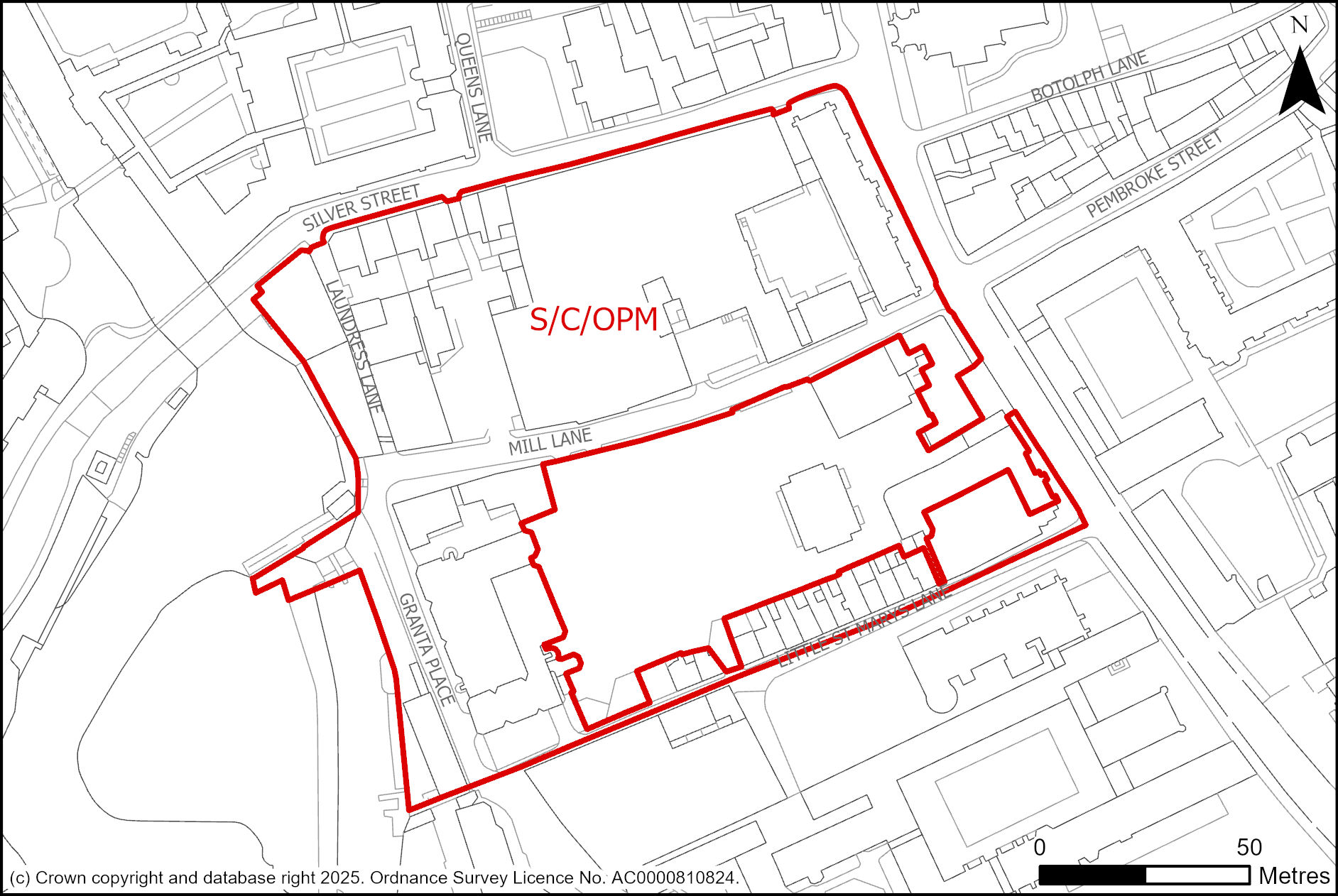
S/C/OPM: Old Press/Mill Lane
- Site area of 1.47 hectares.
- Allocation to provide mixed use student accommodation (approximately 256 student rooms) and faculty buildings, commercial business and service in Class E (a), (b) (c) (food and drink floorspace) and other ancillary facilities. Capacity subject to detailed proposals for university related uses.
1. Development proposals must demonstrate how they will meet the following requirements:
a. Development must protect and enhance the setting and character of the Historic Core, Central Conservation Area and any listed assets within, or in close proximity to, the site including (but not limited to) Grade II listed buildings within the site and, the Grade I and Grade II Listed Queen’s College Buildings, and the Grade II listed Pitt Building adjoining the site;
b. A Heritage Impact Assessment must be provided to demonstrate the potential impact of development on nearby listed buildings; and
c. Development proposals should take reasonable opportunities to introduce active frontages at ground floor level;
d. Given the area’s potential for archaeological remains, development proposals must be accompanied by an appropriate archaeological assessment which includes information on the significance of the heritage asset, including the extent, character and condition of the archaeological resource and the likely impact of the development on the archaeological remains.
Supporting information
This 1.47 hectare site is allocated for mixed use Student accommodation and faculty buildings, commercial business and service-E(a), (b) (c) (food and drink floorspace) and other ancillary facilities. Other uses, including community uses, may be acceptable within the site area.
The site is located within the Cambridge City Centre Historic Core, part of the Central Conservation area; therefore, the site is in a sensitive historic environment. Detailed assessment of the buildings and streets within the Old Press/Mill Lane site is provided in the Council’s Cambridge Historic Core Conservation Area Appraisal (2016). The appraisal notes the significant potential opportunity for redevelopment or re-use of the university buildings along Mill Lane and highlights the main environmental enhancement opportunity as being the floorscape, which could be made more consistent to provide greater visual cohesion. More formal arrangements for on-street parking could help to manage the currently cluttered appearance.
There are no Grade I, II* or II listed buildings within the site but the site has a number of Listed Buildings in close proximity and there are Buildings of Local Interest (BLI) located within the site. As a result of development proposals, the setting of Listed Buildings in close proximity to the site, the Cambridge Historic Core and, and the Central Conservation Area and its setting, should be protected and enhanced (where the opportunity to do so arises through the improvement of the surrounding public realm). Buildings of Local Interest (BLI) within the site (the Anchor Pub and Laundress Lane Warehouse), together with other buildings identified as making a positive contribution to the Central Conservation Area.
Although this site is highly accessible due to its City Centre location and proximity to public transport, pedestrian and cycle movements should have greater priority than at present. Conflict exists at the junctions of Mill Lane/Trumpington Street/Pembroke Street, Mill Lane/Granta Place, Laundress Lane/Mill Lane, Laundress Lane/Silver Street and the corner of Silver Street Trumpington street. Redevelopment must ensure that accessibility and permeability of the site is improved and, safer streets are created with priority for pedestrians and cyclists inclusive of public realm and landscape improvements.
The landscape structure to the west of the site is strongly characterised by the green corridor that sweeps into the City along the River Cam and through the Laundress Green/Sheep's Green and Coe Fen areas. These areas form part of the Cambridge Green Belt and, along with the River Cam, are designated as County Wildlife Sites. These semi-natural open spaces are informal in character, with veteran trees and livestock grazing within metres of the City Centre's streets. The views across these areas, particularly towards Peterhouse, give the impression of a walled town. It is the relationship between the built form and the semi-natural character of these open spaces that forms the transition from the wider countryside around Grantchester to the distant south-west of the Old Press/Mill Lane site and the more highly managed grounds of the nearby Backs and Colleges. There is little in the way of green space within the Old Press/Mill Lane site. In addition to the open spaces of Laundress Green/Sheep's Green and Coe Fen, the churchyard of Little St Mary's Church (to the south of the site), is the only other significant area of open space within close proximity.
The site has the potential for biodiversity enhancement through appropriate landscaping and the greening of open spaces and buildings. For example, tree planting would improve amenity and legibility, and enhance biodiversity and air quality. To maximise biodiversity value, native trees of local provenance should be used wherever possible. Pipistrelle bats are also known to be present in the area and therefore there is the potential for existing buildings and trees within the Old Press/Mill Lane site to support roosting bats.
The site is located in an area of high archaeological potential in the medieval core of the historic City of Cambridge. Trumpington Street is one of the main historic routes out of Cambridge and the medieval Trumpington Gate was located here. The location of the site, within the historic core of Cambridge, on an important access route and straddling the city defences, is highly significant and any surviving archaeological remains in this area will be key to adding to our understanding the early development of the town. Additionally, archaeological research undertaken in support of the application 18/1930/FUL indicates the potential for surviving archaeological remains from at least the 11th – 12th centuries. Therefore, given the area’s potential for archaeological remains, development proposals must be accompanied by an appropriate archaeological assessment.
Tell us what you think
We will consider all comments while developing the next version of the Local Plan.
All comments must be received by 30 January 2026 at 5pm.