What this policy does
This policy sets out how developments should take account of our changing climate and how design and placemaking can be used to help address the challenge of climate change, including overheating.
Policy CC/DC: Designing for a changing climate
1. Planning applications must demonstrate that design solutions have been appropriately integrated that positively respond to our changing climate and reduce climate risks.
2. Development proposals should reflect the cooling hierarchy priority order to minimise the impacts of overheating in the built environment and reduce the demand for air conditioning systems.
3. All new dwellings shall be designed to benefit from cross ventilation where possible, and take passive, design-led approaches to reducing excess solar gain.
Supporting information
Placemaking is a powerful tool in helping to enhance the climate resilience of communities. Early consideration of the design, layout and scale of proposals can help enhance the adaptive capacity of new development – further guidance is provided in the National Model Design Code.
The Met Office’s UK Climate Projections highlight that even under lower emission scenarios, the UK will still see higher average yearly temperatures and an increase in extreme weather events due to historic greenhouse gas emissions. In response to these challenges, the Councils declared a climate emergency in 2019. Overheating, particularly in urban areas, is becoming an increasingly problematic consequence of climate change, which can have potentially serious impacts on human health. The Committee on Climate Change has recommended that planning policy must ensure that overheating risks in our homes and workplaces are mitigated through the early design stages.
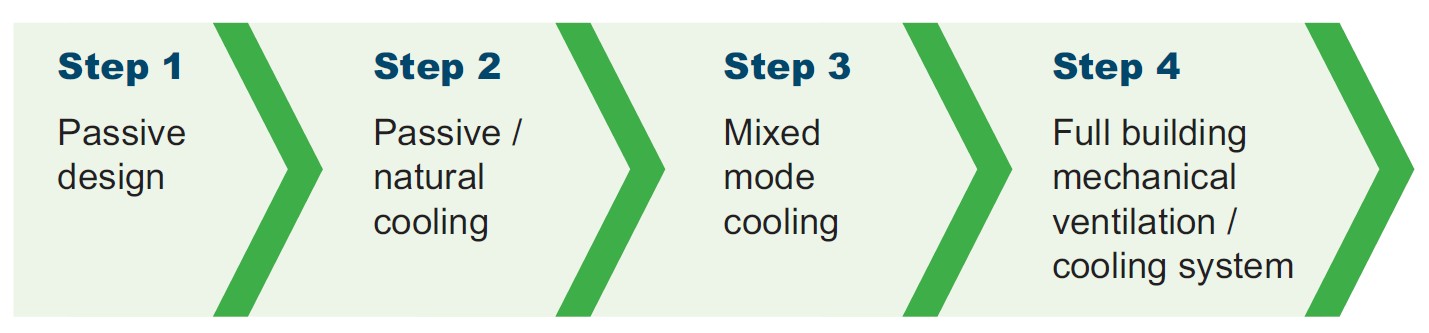
The cooling hierarchy priority order, as illustrated by Figure 128, is as follows:
1. Prioritise passive design solutions: Minimise internal heat generation through energy efficient design and reduction of the amount of heat entering the building in the summer and shoulder months through consideration of orientation, overhangs and shading, albedo, fenestration, insulation and green roofs. Where heat is to be managed within the building through exposed internal mass and high ceilings, provision must be made for secure nighttime ventilation to enable night purge to take place.
2. Then look to passive/natural cooling solutions: Use of outside air, where possible precooled by soft landscaping, a green roof or by passing it underground to ventilate and cool a building without the use of a powered system. This includes maximising cross ventilation, passive stack and wind-driven ventilation, and enabling night purge ventilation. Single aspect dwellings should be avoided for all schemes as effective passive ventilation can be difficult or impossible to achieve. Windows and/or ventilation panels should be designed to allow effective and secure ventilation.
3. Then look to mixed-mode cooling solutions: Using local mechanical ventilation/cooling provided where required to supplement the above measures using (in order of preference): i) low energy mechanical cooling (e.g. fan powered ventilation with/without evaporative cooling or ground coupled cooling); or ii) air conditioning – not a preferred approach as these systems are energy intensive.
4. Then look to full-building mechanical ventilation/cooling systems: Ensuring the lowest carbon/energy options are selected and are only considered after all other elements of the hierarchy have been utilised.
It is recommended that thermal modelling be undertaken to understand the performance of a proposed new development, with buildings designed and built to meet the Chartered Institution of Building Services Engineers’ (CIBSE) latest overheating standards.
Design solutions that may assist in responding positively to the climate emergency and reduce climate risks include:
- using nature-based solutions, such as green infrastructure and enhancing tree canopy cover, to contribute to reductions in the urban heat island effect;
- considering the impacts of built form on microclimate, including solar access, heat and wind flow;
- designing for the long-term implications of increased flood risk by integrating sustainable drainage systems as part of a development’s landscape design to manage flood risks from more unpredictable weather and avoiding development in areas identified as likely to flood in the future;
- prioritising the use of cool materials and features such as cool roofs and pavements both in landscaping and building design;
- designing for accessible communities by minimising the need to travel, creating high-quality links with both active and public travel networks, and delivering measures that promotes sustainable travel practices (e.g. easily accessible and secure cycle storage) in line with Policy I/ST; and
- simplifying the ability to adapt buildings through internal arrangement, internal height, and resilient design such as the use of internal stud walls to allow for easier reconfiguration of internal layout and incorporation of Circular economy principles.
To consider how design can reduce excess solar gain, it is recommended that applications for new homes refer to the Good Homes Alliance Overheating Toolkit. This can be used to identify early design stage approaches to mitigating risk prior to assessment via Part O of the Building Regulations.
Supporting topic paper and evidence studies
- Greater Cambridge Net Zero Carbon Study (2021)
Tell us what you think
We will consider all comments while developing the next version of the Local Plan.
All comments must be received by 30 January 2026 at 5pm.