What this policy does
This policy sets out how new development should provide new and enhanced open space to meet the needs it generates.
Policy BG/EO: Providing and enhancing open spaces
1. New development must address the open space needs it generates, which will be secured through a mix of on‐site provision and/or financial contributions for off-site open space provision, enhancement and/or management.
2. The Councils are exploring the potential to require the following standards for major residential development:
a. An Accessible Green Space quantity standard to be confirmed per 1,000 population, to secure provision of parks & recreation space, country parks, natural/semi-natural green space, and informal areas of open space.
i. As part of the Accessible Green Space quantity standard, the Councils are exploring the potential to:
1. apply a standard for major development in higher density contexts; and
2. secure provision and/or contributions specifically for large scale green spaces including country parks.
b. 0.55ha children’s play space and youth space per 1,000 population;
c. 0.4ha food growing space per 1,000 population;
d. Outdoor sports facilities appropriate to the scale and location of the development, informed by needs identified in the Greater Cambridge Interim Sports Strategy and Greater Cambridge Play Strategy or successor documents.
3. The Councils will require an Accessible Greenspace standard for commercial development, likely to be applied to development in use classes E(g)(i), E(g)(ii), or E(g)(iii) for 100 employees or more (as calculated using the Councils’ latest jobs density calculations). The Councils are continuing to explore the number of hectares per employee to apply within this requirement.
4. The scale and types of open space to be provided on site, and the contribution to offsite provision, must be agreed with the Local Planning Authority, having regard to:
a. local area provision and gaps in accessible greenspace when compared against Natural England’s Accessible Greenspace Standards – size and proximity standards; and
b. site-specific local constraints and opportunities associated with the nature of the proposed development.
5. Development proposals must demonstrate how any on-site or off-site open space provided will be of high quality, having regard to the latest best practice guidance for each type of open space provided. The Councils are exploring the benefits of including specific quality standards for certain typologies, including acknowledging the difference between condition and function of open spaces.
Supporting information
Open spaces, regardless of ownership, are a key aspect for high-quality urban and rural environments, often defining the character of an area. These spaces provide places for relaxation and socialisation, promote healthier lifestyles through opportunities for sport and informal play, and can deliver wider benefits for nature by creating habitat, contribute to cooling and play a key role in adapting to climate change. The character of Greater Cambridge is significantly shaped by its green spaces, trees, and landscape features, including the River Cam.
As referred to in Policy BG/GI, the Councils are continuing to develop evidence to inform the standards for the quantity, quality and accessibility of greenspace provision used within this policy, as part of seeking to implement Natural England’s Green Infrastructure Framework (NEGIF) at a local level. Alongside the draft plan we are publishing Greater Cambridge Green Infrastructure Strategy – Emerging Strategy & Standards. This document includes a set of proposed Green Infrastructure standards and also emerging approaches to developing other potential Green Infrastructure standards, as reflected in the draft policy.
Development proposals will be expected to at least meet the minimum standards for specific open space categories. The quantity standards can be met by direct provision of new and/or improved open spaces on and/or off-site, or through an appropriate financial contribution to off-site provision as appropriate.
Residential development will be expected to contribute to providing publicly accessible green space on a per 1,000 population basis. For quantity, the NEGIF proposes that Local authorities have at least 3 hectares of publicly accessible greenspace per 1,000 population and there is no net loss or reduction in capacity of accessible greenspace per 1,000 population at an area-wide scale. Greater Cambridge currently has approximately 8.7ha of publicly accessible greenspace per 1000 population, comprising Parks & Recreation Space, Country Parks, Natural/Semi-Natural Green Space, Food Growing Spaces, Informal Areas of Open Space, Burial Grounds & Churchyards, and Children & Young People Space. At this draft plan stage, the policy set out here forms a work in progress position; further work will be done to confirm the appropriate quantity standard to apply for the Proposed Submission stage, noting that the standard will be a mechanism for securing off site contributions as well as onsite provision.
Residential developments will be expected to contribute to children’s and play and youth space, food growing and outdoor sports facilities – we are proposing specific standards for these at draft plan stage drawing on our existing evidence. Quantity requirements for specific typologies will be excluded from the overall accessible green space standard to ensure no double counting.
In high density residential development where there is a limited amount of space available, the priority is to incorporate good quality doorstep scale accessible greenspace on-site, or close to the site, that enable the residents to have access to greenspace where they live. The Councils are exploring how a standard could apply to address this need.
The Councils are also exploring the most appropriate way for development to contribute to meeting the Greater Cambridge’s evidenced need for additional strategic scale green space including for country parks.
To maximise opportunities for the working population to access green spaces for gathering, relaxation and informal recreation, on-site open space provision will be sought for development proposals for employment uses with E(g)(i), E(g)(ii), or E(g)(iii) for 100 employees or more. The Councils are developing evidence to determine the most appropriate standard to meet this need. The number of employees will be calculated using the Councils’ latest job density calculations. Where appropriate, any provision should be made available to the wider community outside of working hours.
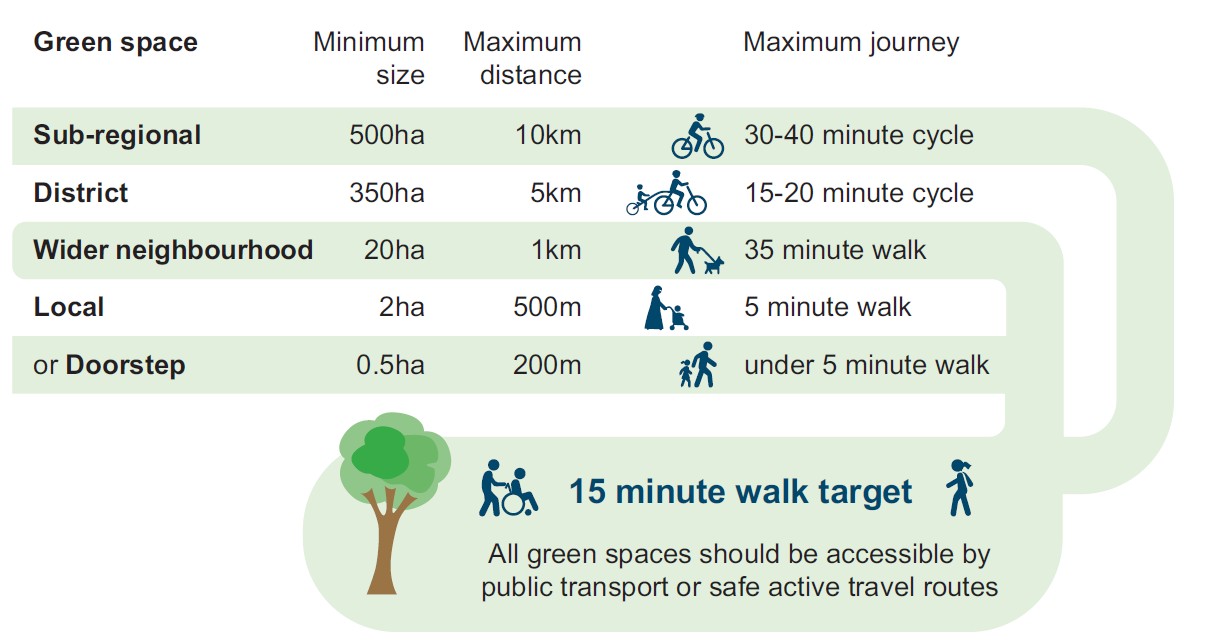
Natural England’s Accessible Greenspace Standards identify required provision of different scales of green space at different distances from development. Development should demonstrate how provision of on site open spaces responds to gaps in existing provision in the locality when considered against these standards. Our Green Infrastructure Strategy includes analysis of Greater Cambridge’s existing provision against the NEGIF size and proximity standards.
To ensure the any on-site open space provision is of a high quality, development proposals will be expected to demonstrate that any provision is of a high quality with regard to best practice guidance. This can be demonstrated through the submission of a standalone document or as part of a design and access statement.
Financial contributions for off-site provision will be calculated using the Greater Cambridge Green Infrastructure Strategy, Greater Cambridge Interim Sports Strategy and Greater Cambridge Play Strategy.
Contributions towards off-site facilities will be directed to enhancing existing local green space and/or delivery of schemes that support the delivery of the objectives of Greater Cambridge Strategic Green Infrastructure Initiatives identified in Policy BG/GI Green Infrastructure. Contributions will also be directed towards management of green space where appropriate.
Supporting topic paper and evidence studies
- Greater Cambridge Local Plan: Biodiversity and Green Spaces Topic Paper
- Greater Cambridge Green Infrastructure Strategy - Volume 1 - emerging strategy and standards (2025)
- Greater Cambridge Green Infrastructure Strategy - Volume 2 - Supporting Evidence (2025)
- Greater Cambridge Interim Sport Strategy (2025)
- Greater Cambridge Play Strategy (2025)
Tell us what you think
We will consider all comments while developing the next version of the Local Plan.
All comments must be received by 30 January 2026 at 5pm.