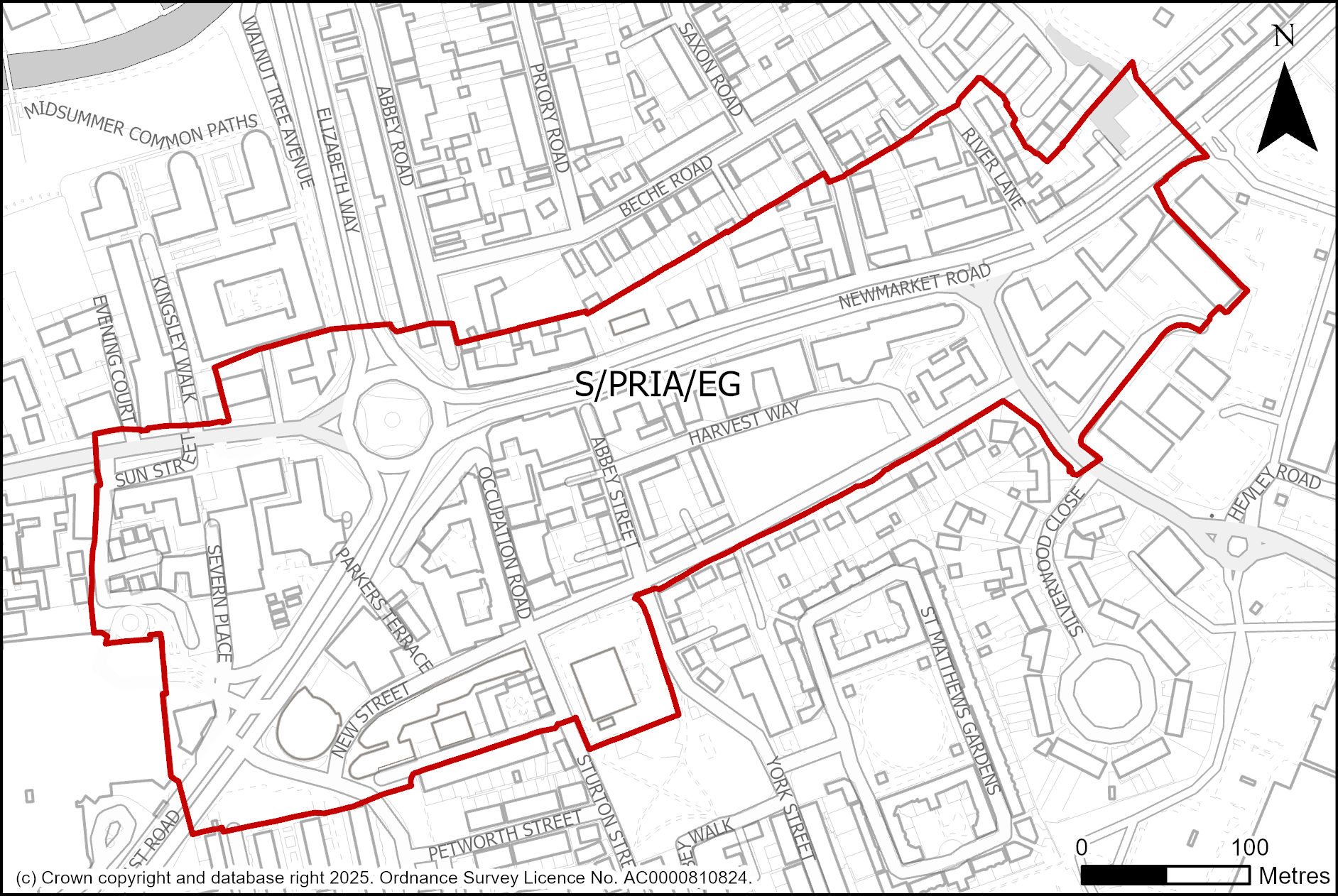
1. Development proposals within the Eastern Gate area will be supported if they:
a. enhance the character of the area and improve connectivity;
b. enhance existing and/or provide new direct crossings that respond to key walking and cycling desire lines; and
c. deliver coordinated streetscape and public realm improvements to streets and junctions within the Eastern Gate area;
d. create opportunities for new public spaces;
e. create improved visual and physical connections between existing and newly created open spaces; and
f. integrate positively with the adjacent Cambridge Retail Park (Policy Ref. S/PRIA/CRP), Beehive Centre (Policy Ref. S/AMC/BC), Fitzroy/Burleigh Street/Grafton Area (Policy Red. S/AMC/FBG) and surrounding neighbourhoods.
2. Proposals will be required to provide a movement strategy integrating with any proposals the Greater Cambridge Partnership or the Transport Authority may have for the wider area. Where feasible, proposals should:
a. support the creation of a low vehicle speed environment to help restore the balance between people and vehicles;
b. emphasise ‘place making’ over vehicle movement, in particular at junctions, through the use of tighter geometry and radii, to reduce speeds and to reclaim public open space;
c. reinforce or re-establish historic routes: integrating with or supporting any proposal for the future re-modelling of Elizabeth Way Roundabout and the re-establishment of the historic route and direct visual links between Occupation Road and Abbey Road; and
d. create a more comfortable and simplified pedestrian environment by providing wider pavements and more street trees, removing pedestrian guardrails and unnecessary signage, and introducing more direct crossings that respond to key desire lines.
3. An urban design led approach should be taken to inform the appropriate scale and massing of development proposals in the policy area. Proposals will provide townscape analysis and a character appraisal of the area to evidence how development will achieve well designed buildings that fit into their wider context, improve connectivity and movement, and enhance the character and open space of the area. Studies will also be required to justify proposed land uses floorspaces and their redevelopment on a proposal-by-proposal basis.
Supporting information
The Eastern Gate Opportunity Area stretches from the Crown Court and Elizabeth Way roundabout to the beginning of the Newmarket Road retail park and has in recent years seen significant changes. Historically the large-scale highway interventions of the 1970s, the application of standard highway engineering solutions and the construction of unsympathetic bulky buildings that do not relate well to the public realm, particularly along the key arterial route of Newmarket Road have eroded the quality and character of the area and created barriers between neighbouring communities.
Despite these challenges, attractive, well-established spaces and neighbourhoods with a strong sense of community still exist in the area surrounding the Eastern Gate. There are variations in character across the Eastern Gate area with large scale retail development to the east and mixed-use 20th Century retail, residential and office developments to the west. The area also includes several landmark/listed buildings including the listed Church if St Andrew the Less and a cluster of Grade II listed assets to the north centred on Abbey House, Grade II listed 247 Newmarket Road (Seven Stars Pub) and also the grade II listed Cambridge Gas Company War Memorial; the Crown Court which forms both a landmark and a point of reference in the urban environment and is one of the tallest buildings in the area.
Development in the Eastern Gate PRIA should support the regeneration and transformation of this key approach to the city through high quality development that will connect people and places. Opportunities for improving the area exist in the successful integration of new development and, for rediscovering and realising the potential of underused spaces and in redevelopment opportunities.
An urban design led approach should be taken to inform the appropriate scale and massing of development proposals in the policy area and to ensure that well-designed schemes are created that fit into their context responding to key views and vistas including into and across the surrounding Conservation Areas (the Cambridge Central conservation area (which includes the Riverside and Stourbridge Common conservation areas). If applicable, proposals should consider how development can make a positive contribution to the Cambridge skyline and in particular, the roofscape of the Central Conservation Area.
Additionally, and where possible, views of the Museum of Technology (Scheduled Ancient Monument) should be protected. Where applicable, studies will be required to justify redevelopment on a proposal-by-proposal basis. For example, proposals along East Road would be expected to incorporate careful analysis of the existing townscape character to inform the site strategy along with the implementation of an integrated approach along both streets for public realm, servicing and street movement and design improvements.
Vehicular traffic dominates Newmarket Road and East Road making informal crossings difficult. Specifically, the underpass, pedestrian guardrails and, indirect crossings which surround Elizabeth Way roundabout limit the accessibility of the area and increase journey times and walking distances. Development proposals should support improvements to people’s ability to travel safely and comfortably by sustainable and accessible modes of transport. For example, providing improved pavements to create a more comfortable and simplified pedestrian environment, by providing safer junctions (for example continuous footway junctions which prioritise pedestrian movement) and enhancing existing/ providing new pedestrian/cycle routes and direct crossing points that follow natural desire lines (rather than forcing people to cross at inconvenient formal crossing points).
Proposals which propose the removal of existing guardrail along Newmarket Road and East Road are only considered appropriate as part of a wider design for the whole of the streetscape. Also, proposals which support reducing the physical and visual width of the carriageway, in addition to reducing or removing road markings and emphasising and improving the gateways/entry points to residential neighbourhoods, will help change the perception of the street and contribute to lower speeds.
Tell us what you think
We will consider all comments while developing the next version of the Local Plan.
All comments must be received by 30 January 2026 at 5pm.