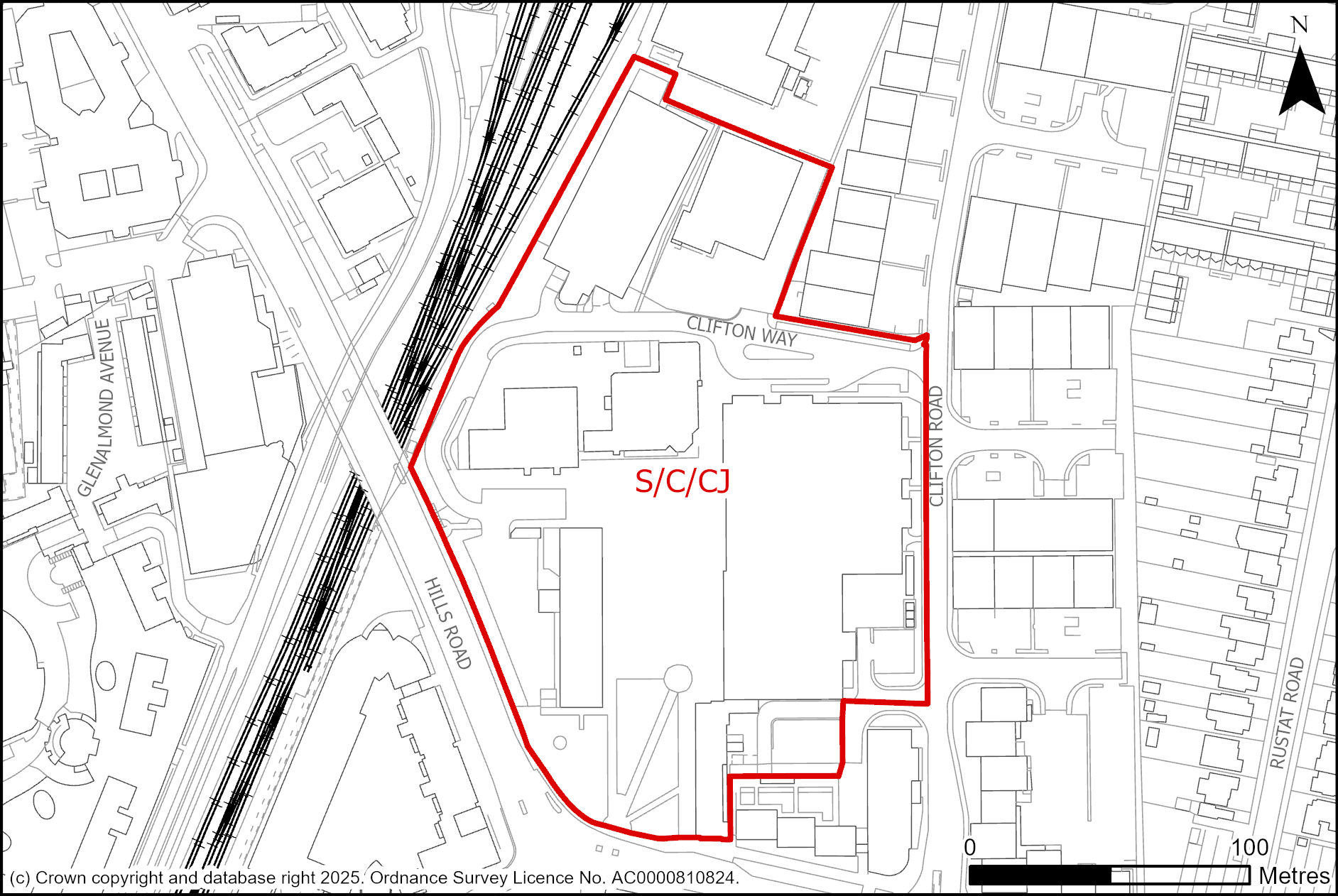
S/C/CJ: Cambridge Junction and Cambridge Leisure, Hills Road
- Site area of 3.39 hectares.
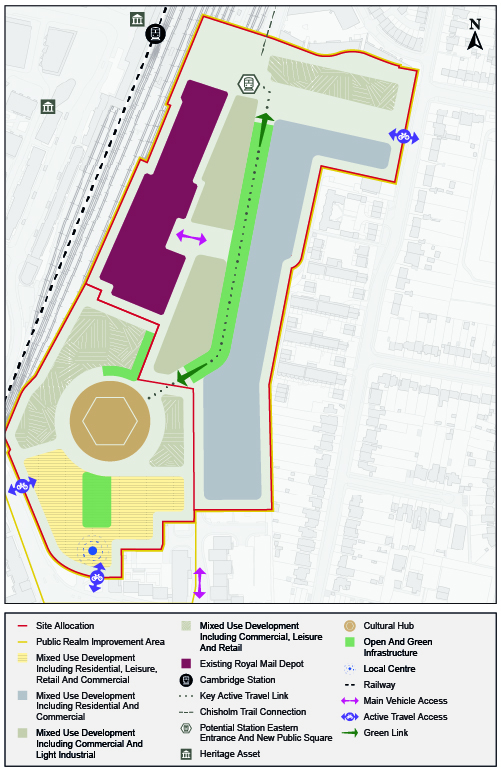
- Cambridge Junction and Cambridge Leisure will develop as a vibrant, reimagined, part of the city that includes new homes, workspaces, leisure, entertainment and culture. Cambridge Junction is a locally and regionally important venue and, alongside a significant new public space, will form the centre of this neighbourhood. Supported with a mix of complementary uses, this area will a place where people can live, work and play throughout the day and evening.
- Capacity for approximately 100 homes, concert and performance spaces (Sui generis), commercial leisure (including food and drink and the reprovision of the bowling alley and cinema),commercial uses including Office (E(g)i), Research and Development facilities (E(g)ii), light industrial (E(g)(iii) and complimentary Hotel (C1) and Storage or Distribution (Class B8).
1. Development proposals must demonstrate how they will meet the following requirements in order to create a vibrant mixed use neighbourhood:
a. A masterplan led approach to the comprehensive redevelopment of the site, ensuring that it aligns with adjacent development proposals within the Clifton Road Industrial Estate (Policy S/C/CLT) and positively responds to any possible future eastern entrance to Cambridge Station;
b. The re-provision and enhancement of Cambridge Junction as a live performance and community venue. Through engagement with local stakeholders and relevant bodies, redevelopment proposals should deliver a range of flexible spaces that can accommodate live shows, community workshops and a dedicated nightclub. If required, temporary venue provision should be provided during the construction phases of the redevelopment to minimise any short term disruption to this important local and regional venue;
c. Redevelopment of the existing commercial leisure units (including cinema, bowling alley and food and beverage outlets) must ensure that these uses are re-provided within the development proposals;
d. The provision of residential uses provided that noise mitigation is addressed at the masterplanning stages of development to ensure there is no adverse impact on residential amenity from surrounding uses.
e. The provision of a range of commercial uses, in particular for start up companies, grow on spaces, workshops and maker spaces;
f. The loss or reduction in Storage or Distribution (Class B8) and/or Hotel provision (Class C1) would need to be justified in accordance with the relevant Local Plan policies;
g. A significant and flexible public space that is the focus of the new development which provides a range of functions, including opportunities for people to dwell, temporary events like pop up markets and spill out and performance space to support Cambridge Junction and adjacent commercial/retail uses;
h. Opportunities to open up the site from Hills Road should be taken to increase the permeability of the site;
i. The provision of a dedicated cycle park which forms part of a travel hub that is well connected with any future phases of the Chisholm Trail and wider cycle infrastructure on Hills Road and Cherry Hinton Road;
j. The re-provision of a multi-storey car park;
k. A new energy centre to support decentralised energy generation for the site;
l. Given the changes in levels, the design of the site should seek to improve its visual relationship with Hills Road where possible;
m. A positive, context-led approach should be taken in relation to the massing, style, and materials of new buildings to limit any negative impacts on the setting of the Grade II Listed Railway Station, the New Town and Glisson Road Conservation Area, and other designated and non-designated heritage assets that are in the vicinity of the site;
n. Given the sites potential to be experienced in a number of strategic viewpoints and from landmark buildings along Hills Road, design mitigation in terms of appropriately tested building heights, the careful orientation of development and appropriate massing is required;
o. Adequate access and servicing arrangements for the range of uses should be incorporated into any proposal. Where possible and practical, access for servicing and deliveries should be managed on-street;
p. Archaeological investigation and mitigation will be required to identify the presence and significance of as yet unknown archaeological remains across the site.
Supporting information
Cambridge Junction is a local and regional music venue and forms an important part of the cultural offer of the City. The allocation also includes Cambridge Leisure, which comprises a mix of commercial leisure uses and food and beverage outlets, and is designated as the Hills Road Local Centre. To the rear of Cambridge Junction is a multistorey car park and self-storage unit. The site is within a highly sustainable location, close to Cambridge railway station and local services and facilities.
Based on landowner discussions, there are aspirations for a comprehensive redevelopment of the site. At the heart would be a new Cambridge Junction, providing a mix of performance space, workshop studios and a dedicated nightclub. The final design proposal of a redeveloped venue would need to be informed by local and stakeholder engagement to ensure it reflects local aspirations and is informed by best practice. Organisations such as the Music Venue Trust should be engaged.
The redevelopment of the Junction should act as the catalyst for regeneration of the site. New and improved commercial leisure uses (including the reprovision of a multiplex cinema and bowling alley) must form part of a diverse entertainment, leisure and food and beverage mix, creating uses and high quality public spaces for people to visit throughout the day and evening. The public spaces should be designed to accommodate a wide range of uses, from public events like pop up markets to performance space, creating a vibrancy to the area that is currently occasionally lacking whilst opportunities should be taken to improve the relationship between the site and Hills Road.
Key to achieving this vibrancy is the provision of a mix of land uses, including new homes and a wide range of employment opportunities based on a fine grain development form. A blended mix of commercial spaces, from spaces to support new and growing businesses to some larger scale office and laboratory space will generate activity throughout the day, whilst residential uses alongside the cultural, leisure and entertainment facilities will generate interest and activity into the evening and at weekends.
A masterplan would need to align with and complement development proposals at Clifton Road Area as well as existing and future active travel plans and projects, including future phases of the Chisholm Trail. The masterplan must also provide a holistic solution to access and servicing, pedestrian and cyclist movement into and through the site and car and cycle parking. The site should also make provision for any possible future eastern entrance to Cambridge Station through the layout of the site and approach to movement and legibility. Given the wide range of uses proposed, there is an opportunity for a new energy centre to serve the site and potentially the wider area.
The site has the potential to be experienced in a number of strategic viewpoints and in the context of Landmark buildings beyond the study area, owing to long views along Hills Road. The proposed mitigation measures within the policy will also ensure no unacceptable impacts on the local and wider skyline, townscape character and listed assets and their setting through appropriate building height, massing and style and materials.
Tell us what you think
We will consider all comments while developing the next version of the Local Plan.
All comments must be received by 30 January 2026 at 5pm.