What this policy does
This policy will guide any future redevelopment at Granta Park.
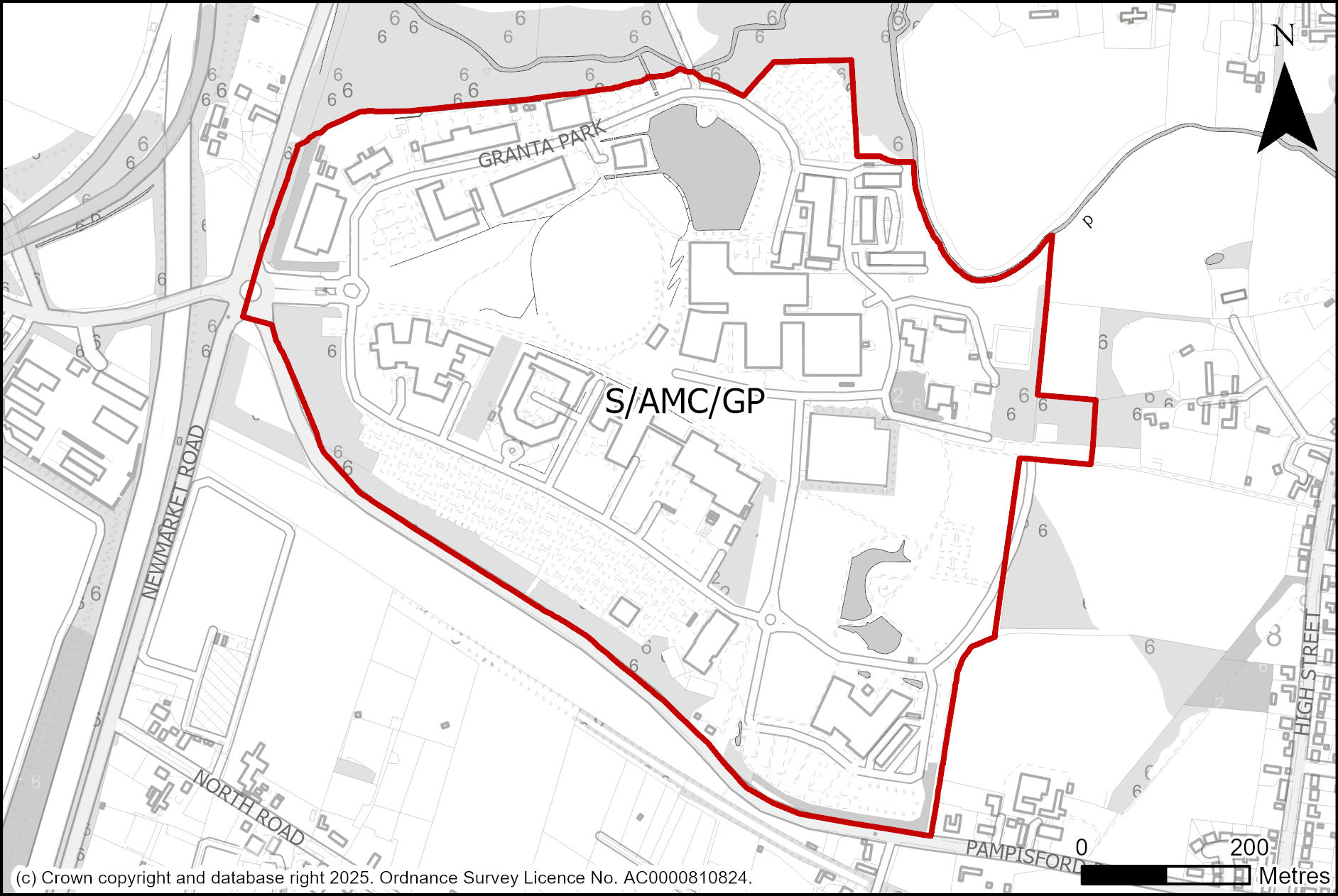
Policy S/AMC/GP: Granta Park
1. Development proposals for the replacement, intensification and expansion of existing buildings at Granta Park, and for appropriate new development, will be supported only where:
b. They demonstrate that the reuse of existing buildings has been explored first before considering expansion and appropriate new development;
c. There is no loss of Class (E(g)(ii)) research and development floorspace, reflecting the primary function of the campus, or where there is a sufficiently justified community benefit;
d. The design, including building heights, massing and materials, responds sensitively and positively to the existing built form and parkland setting, maintains and enhances connections with key landscape features, including the corridor of the River Granta, and avoids unacceptable adverse impacts on the Grade II* Listed Abington Hall, the adjoining Great and Little Abington Conservation Area and other nearby designated heritage assets;
e. Existing open spaces are maintained and, wherever possible, enhanced;
f. There are no resultant adverse impacts on the nearby Alder Carr SSSI;
g. They contribute financially to strategic public transport and active travel schemes in the south-east corridor appropriate to the scale and nature of the development; and
h. There is adequate provision for supporting services and facilities to support those working and visiting the site, including external amenity spaces. This should be considered as part of a holistic Amenity Strategy.
Supporting information
Granta Park is a major centre of skilled employment and part of an established network of science and technology campuses in the Rural Southern Cluster. Granta Park was first established in 1997 and has seen several applications for redevelopment and renewal of its buildings in recent years. As a result of the significant demand for high quality research and development floorspace across the plan area, this policy is needed to guide and manage this ongoing renewal and maximise the potential of its existing footprint.
This includes ensuring that developments seek to preserve and enhance its unique setting and features, responds positively to nearby heritage and environmental assets, and wherever possible secures enhanced connections to nearby active travel networks to help mitigate any adverse impacts on the local highways network and complement the general approach to sustainable transport taken elsewhere in the plan (set out in Policy I/ST).
Supporting topic paper and evidence studies
Greater Cambridge Local Plan Sites Topic Paper
Tell us what you think
We will consider all comments while developing the next version of the Local Plan.
All comments must be received by 30 January 2026 at 5pm.