What this policy does
This policy will guide the future expansion and development of the existing Wellcome Genome Campus site and support the continuing success of a nationally significant facility for the development of genomics and bioinformatics and its associated applications for people to live, work and visit.
Policy S/WGC: Wellcome Genome Campus, Hinxton
Vision and identity
1. The expanded Wellcome Genome Campus, along with the renewal and selective redevelopment of the existing campus in line with a dynamic integrated masterplan, will create an exceptional, integrated place encompassing a range of uses for those working, living and visiting the site. It will continue to develop as a centre of excellence for research, building on its internationally significant work on genomics and bioinformatics.
2. The expanded campus will be a landscape-led development, with denser development focused at a series of mixed-use clusters, and a more rural character maintained along the northern edge of the campus. It will be highly sustainable, well connected internally with active travel connections, and more widely with other settlements. The campus will be embedded in a network of multi-functional green infrastructure that will foster social interaction and collaboration, conducive to the campus ethos. This will be emphasised by the strong links with campus workers living on site, in what will be an exceptional, world leading, stimulating and sustainable environment.
Uses
3. The Wellcome Genome Campus is allocated for mixed use development, comprising the following:
a. Approximately 127,500 square metres (GIA) (150,000 square metres (GEA) flexible employment uses, including research and development office and workspace (E(g));
b. Approximately 1,500 residential dwellings (C3) for campus workers;
c. Approximately 3,500 square metres (GEA) retail space (E (a, b, c) and Sui Generis) to support the day to day needs of those living, working and visiting the campus;
d. Approximately 5,000 square metres (GEA) hotel (C1);
e. Approximately 22,750 square metres (GEA) total non-residential institutions and community and leisure uses, including nursery, conference facility, and education. Education facilities include a primary school which would need to be phased with the delivery of new homes within the site;
f. Healthcare facilities to meet the needs of the development;
g. Data storage (sui generis) and processing facilities, where there is a demonstrated need;
h. Redevelopment of existing buildings for employment or associated uses will be supported, including supporting uses (including Use Classes F1 and F2); and
i. A range of suitable employment units, including start-ups, SMEs and incubator units.
4. These uses are required to ensure the principles, parameters, mitigation and assessment contained within the outline planning permission (S/4329/18/OL) are met, and that the existing campus can be redeveloped where necessary.
5. Any occupants of the employment uses permitted under Use Classes E(g), B2 and B8 must relate to genomics and bioinformatics only.
6. The occupancy of residential properties must be restricted to campus workers. Where housing units are proposed for sale or rent on the open market, justification for this will need to be clearly set out and approved by the Local Planning Authority and in accordance the agreed cascade mechanism with the Sales and Lettings System.
7. Temporary and meanwhile community provision will be required from early occupation until sufficient capacity has been reached for a permanent facility. The size and nature of the temporary provision will need to be considered throughout the build period of the development, ensuing any provision has sufficient flexibility to be able to expand or be repurposed as each phase of the development comes forward.
The development of the Wellcome Genome Campus must do the following:
Context
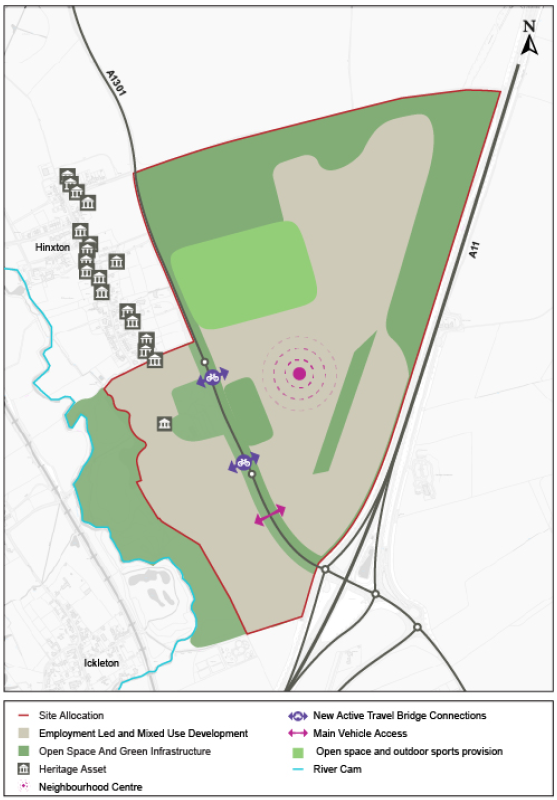
8. Through the use of strategic gaps, maintain separation to the settlement of Hinxton on its north western boundary and Ickleton to the south west.
9. Maintain open buffers between the built areas of the site and:
a. the A1301 to the north west of the site, through retained agricultural land and other open space uses; and
b. the River Cam to the south of the site, through a landscaped buffer.
10. Through the preparation of a Landscape Visual Impact Assessment and Heritage Impact Assessment, give careful consideration to the protection and enhancement of heritage assets and their settings, including:
a. Grade II* Listed Hinxton Hall, located to the north of the site, as well as other nearby Listed Buildings; and
b. Hinxton Conservation Area to the east. Design mitigation, such as careful consideration of building height limits, massing and grouping, together with landscape buffers and tree planting, will be required to reduce impacts, especially in the eastern part of the site where there are extensive views between the campus and the Hinxton Conservation Area.
11. Given the known significant potential for archaeological remains in this area, development proposals must be accompanied by an appropriate archaeological assessment, which includes information on the significance of the heritage asset, including the extent, character and condition of the archaeological resource and the likely impact of the development on the archaeological remains.
Built form
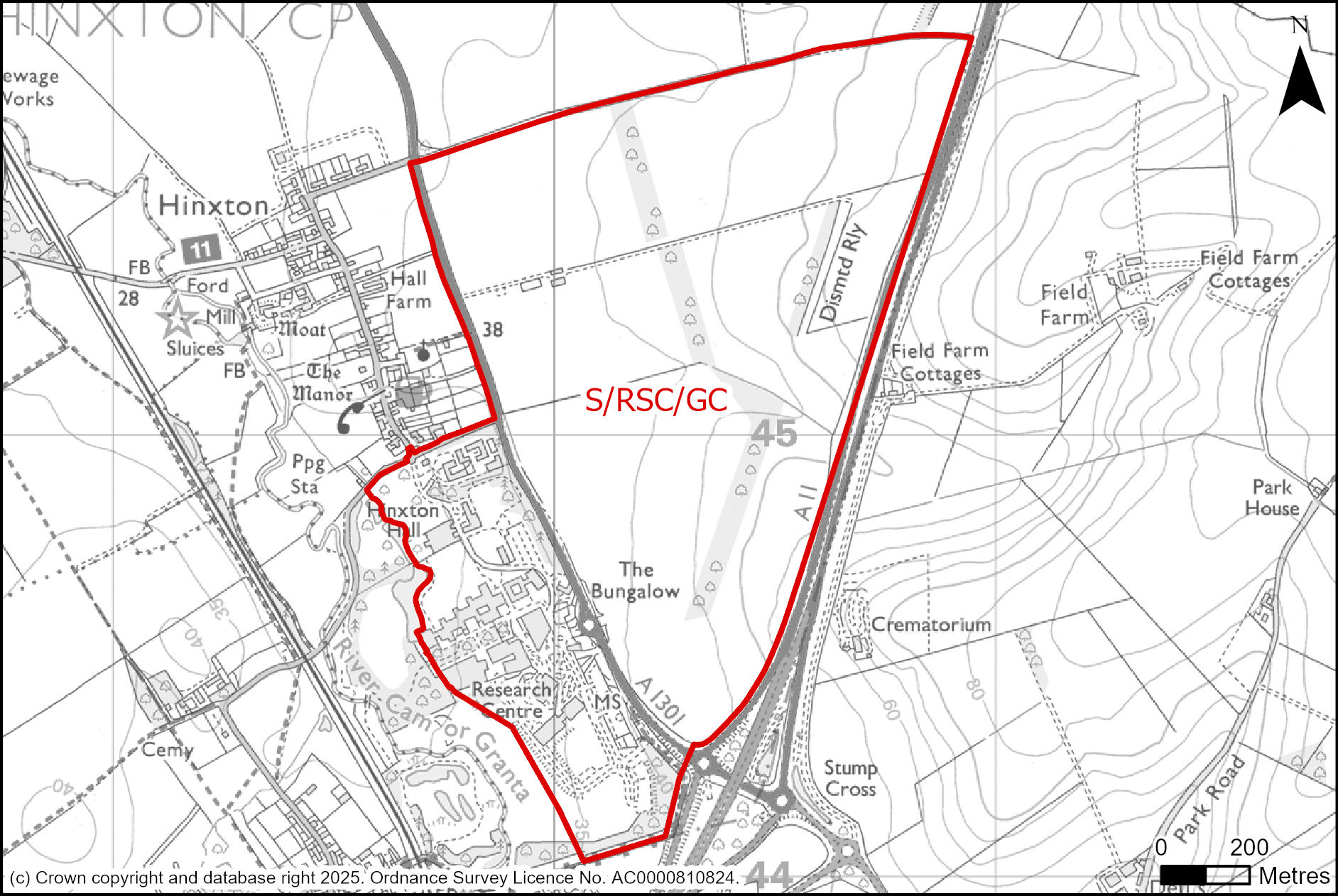
12. Ensure the built area of the campus is contained within the site allocation boundary shown on the policies map.
13. Be comprehensively planned and delivered to ensure that development proposals do not prejudice the creation of a fully cohesive and successful campus. This must involve:
a. providing a Masterplan for the whole campus where significant or major changes are proposed within the existing campus to ensure there is alignment with the proposed expansion;
b. demonstrating, through the use of Design and Access Statements, compliance with the approved Strategic Design Guide or any successor document.
14. Maximise opportunities for intensification of built form on the existing Campus to make best use of the land available and ensure the campus can respond to modern business and research needs, whilst ensuring the protection of amenity and delivery of biodiversity enhancements.
15. Concentrate mixed uses around a central Green, including retail and community facilities, which must be accessible to all.
16. Provide a landscaped noise attenuation bund along the eastern edge of the site adjacent to the A11.
Public space
17. Deliver a network of multi-functional public spaces, connected by linear landscaped connections throughout the site, including:
a. Public open space, made up of allotments and community gardens, outdoor sports, children's play space, and informal open space;
b. A central green that provides for different functions, including rain gardens, a LEAP, SUDS features including a water feature, events space, and pedestrian and cycle connectivity routes;
c. A linear park that provides for a neighbourhood equipped area for play (NEAP), locally equipped areas for play (LEAPs), community gardens, incidental play, structural landscaping, and a primary pedestrian/cycle route
d. Other linear structural landscaped routes, including parks and gardens, incidental play, productive planting and secondary pedestrian/cycle routes;
e. Indoor and outdoor civic spaces located in areas that encourage social interaction and collaboration and can accommodate sustainable travel hubs and incidental play; and
f. A range of outdoor sports provision, including:
i. An area equivalent to at least three hard surfaced tennis courts for a range of racket sports;
ii. One third generation (3G) MUGA, including lighting;
iii. A pavilion/changing facility with toilets to support these facilities; and
iv. Grassed recreation ground that could accommodate a 400m running track.
Nature
18. Protect and enhance ecological assets, in particular the Wellcome Trust Nature Reserve, River Cam and the railway cuttings.
19. Ensure retention of:
a. existing railway cuttings, where necessary, to provide woodland features; and
b. agricultural fields in the north and north-west of site for agricultural use, which must be improved for biodiversity where feasible.
20. Introduce access to existing natural environments, including the existing railway cuttings, Wellcome Trust Wetland Nature Reserve, River Cam, and the wider countryside via footpaths, cycleways and where appropriate bridleways, being careful to minimise recreational impacts on any ecological habitats or species.
21. Create new ecological features, including:
a. a woodland to the north west of the site; and
b. strategic landscaping that forms part of a wider green and blue infrastructure network across the site and beyond.
Movement
22. Provide a legible and comprehensive movement network for the whole campus that interconnects those who live and work on the site, and to wider networks beyond, to encourage the use of sustainable modes of transport and travel. Measures to promote walking and cycling must include:
a. The provision of safe, attractive and seamless pedestrian and cycle connections across the whole campus that link homes, civic spaces, education facilities and employment areas, and based on active travel principles;
b. Safe grade separated crossings for pedestrians, cyclists and other non-motorised users to ensure the campus is fully integrated;
c. The provision of high quality cycle priority streets; and
d. Delivery of at least two pedestrian/cycle bridges that span the A1301, connecting the existing campus with its expansion
23. Delivering direct and rapid transit connectivity interventions to assist improved connectivity with the Campus to Whittlesford Parkway Station and the South Eastern Travel Hub.
24. Contributing financially to strategic public transport and active travel schemes in the south-east corridor, appropriate to the scale and nature of the development.
25. Designing and delivering a site wide approach to car and cycle parking provision.
26. Securing general public access to the existing and expanded campus, which may include securing additional pedestrian/cycle and vehicular access points, as necessary.
Resources
27. Make provision for an ambient loop and an energy centre.
28. Incorporate innovative approaches to reducing the water demand associated with cooling of a data centre(s), with a preference for cooling methods that either do not require water use or which utilise non-potable water.
Lifespan
29. The applicant must undertake meaningful engagement with the local communities and stakeholders at the relevant Reserved Matters stages, and as part of other applications, where deemed necessary.
Supporting information
The Wellcome Genome Campus, Hinxton is set within and adjacent to the estate of Hinxton Hall on 125-acres of landscaped parkland bordering the River Cam. The Campus is the world’s leading centre for genomics research, having played a central role in the Human Genome Project (1990-2003), which read and recorded the complete sequence of DNA in an individual for the first time.
In 2020 South Cambridgeshire District Council granted outline planning permission for a mixed-use development which would provide up to a further 150,000 square metres GEA of new research and translation floorspace. The Wellcome Trust want the Campus to become a leading international centre for scientific, business, cultural and educational activities arising from genomics and biodata. It estimates that around 4,300 new jobs will be created by the expansion of the campus.
The jobs will be accompanied by up to 1,500 new homes specifically for Campus workers, along with land for a new primary school, a nursery and community facilities, public open spaces and allotments. The overall vision is to create a ‘one campus’ that is dynamic, amenity rich and highly sustainable environment which is a leading global centre for genomics and biotech. As part of the one campus approach the whole campus will become accessible to the general public.
The planning permission for the development includes a range of requirements and criteria designed to recognise the unique nature of the site and ensure future uses support the primary role of the campus for the development of genomics and bioinformatics. The Section 106 Legal Agreement to the outline planning permission provides a mechanism for specifying and agreeing future occupants within the expansion land. However, as the policy is for the whole campus it would be reasonable to stipulate that future employment uses are limited to genomics and bioinformatics only.
The site is also located within the Rural Southern Cluster which supports a number of sites for research and employment. Given the potential growth within the Rural Sothern Cluster there is an opportunity to provide improved connectivity with sustainable transport interventions. This would potentially connect the Campus with Whittlesford Parkway Station and the South Eastern Transport Hub.
Active Travel principles will be used throughout the Campus, prioritising pedestrians and cyclists. Within the expansion land cycle streets will be utilised prioritising cyclists over vehicles. A network of primary and secondary pedestrian and cycle routes will permeate through the campus. At least two pedestrian/cycle bridges will be provided which will connect the existing campus with the expansion land. This will allow for improved connectivity and permeability.
The existing campus is recognised in the South Cambridgeshire Local Plan 2018 as an ‘Established Employment Area in the Countryside’. However, given the scale and range of uses now permitted within the site, and as a major expansion to it, a new policy is needed.
Within the existing campus, appropriate development and redevelopment will be supported, subject to other policy considerations. This will enable more efficient and enriched campus allowing the adaptation for the needs of existing and future users. It is likely that any development or redevelopment within the existing campus will exceed the ‘built form’ thresholds as set out within the policy. Where development may exceed the ‘built form’ thresholds it will need to be supported by a detailed masterplan for the campus.
Proposed development within the expansion land should adhere to the approved Design Guide or successor documents. The Design Guide sets out a number of development principles and supporting guidance to steer proposals as they come forward.
The exceptional qualities of the landscape, particularly associated with Hinxton Hall, the River Cam and the wetlands will be protected and enhanced, and all new proposals must demonstrate alignment with and contribution to delivering a landscape led vision for the community and place as a whole. The whole campus will be characterised as an amenity that is rich in biodiversity.
It will be necessary to retain a landscape buffer between the north western part of the site and the A1301. It is important to have a distinct separation between the existing settlement of Hinxton and the new development. The landscape buffer would be in the form of an agricultural land and other recreational uses. It is also necessary to provide a landscaped noise attenuation bund to the eastern part of the site in order to reduce potential noise impacts arising from the A11. Other landscape mitigation will be considered on other parts of the site where necessary and justified.
Green Infrastructure (GI) will also be provided within the campus. The existing campus already provides for well landscaped parkland and other amenity landscaping. Such landscaping is integral to the setting of Hinxton Hall and of the wider built form of the Campus. The expansion land will incorporate various GI including formal and informal open space, allotments and community gardens. Provision will also be made for outdoor sports and children’s play spaces. Proposed GI will come forward in accordance with the approved Design Guide or successor documents.
Hinxton Hall is a Grade II* Listed Building and located within the Hinxton Conservation Area. Hinxton Hall plays an integral part of the functioning of the campus, providing a focal point for the existing conferencing facilities. It is important that Hinxton Hall preserved and enhanced. The wider setting of Hinxton Hall provides for formal grounds as well a more informal landscape identified by mature trees and water features.
Other heritage assets include the Stables (Grade II Listed Building) located to the west of Hinxton Hall, the North Lodge (Grade II Listed Building) to north of Hinxton Hall, and the Games Larder (Grade II Listed Building) directly adjacent to Hinxton Hall. It is important to preserve and enhance where possible Hinxton Hall and its setting, and other heritage assets. Engagement with the Conservation Team and Historic England should be undertaken where proposals effect Hinxton Hall and other heritage assets, and their setting.
The site should achieve high sustainability targets for the campus. A site wide ‘ambient loop’ served by ground source heat networks, supported by air source heat pumps and PV arrays, is expected to be delivered throughout the campus. In addition, given that the South Cambridgeshire is within an area of water stress it will be necessary for any proposed data centre(s) to reduce the demand for water use associated with the cooling of such facilities. New cooling technologies should be considered which either do not use water or uses non-potable water. Other sustainability criteria are set out within the Joint Local Plan, though any exceeded targets should be monitored by the developer over the lifetime of the development.
The Biodiversity Net Gain (BNG) targets under the outline planning permission are set to achieve at least 25% across the expansion land. Under the Joint Local Plan, a BNG target of 20% is required. Therefore, the whole Campus should achieve at least 20% with a stretch target of 25% BNG.
The policy reflects the 2020 planning permission (S/4329/18/OL) in terms of use- classes, quantum of development and that future planning applications will need to address local issues including transport, heritage and landscape impacts as part of the phased development of this internationally important life science facility.
Supporting topic paper and evidence studies
Greater Cambridge Local Plan Sites Topic Paper
Tell us what you think
We will consider all comments while developing the next version of the Local Plan.
All comments must be received by 30 January 2026 at 5pm.