What this policy does
This policy provides a context for future development at Eddington, a new urban quarter which is being developed to meet the needs of the University of Cambridge. The site is currently home to around 1,850 homes, greenspace and community facilities, but there is capacity for a higher level of homes than was originally planned on the remaining site. The policy identifies future development capacity, and requirements which will ensure that the high quality of the site is maintained.
Policy S/NWC: Eddington, Cambridge
1. When completed, Eddington will form an extension to Cambridge of approximately 5,500 homes (comprised of market and key worker homes), 2,000 student rooms. A district centre provides The University of Cambridge Primary school, nursery provision, retail and food and beverage offers, hotels, health facilities and community facilities at the Storey’s Field Centre. Ancillary local centres will serve the wider development area to ensure that amenities are within easy walking and cycling distance of all residents. In addition, academic and employment uses, sport and leisure facilities, open spaces, landscape areas and infrastructure works will all be undertaken.
Vision and identity
2. Eddington will continue to evolve into a distinctive, mixed-use neighbourhood that redefines how people live and work in Cambridge. It is establishing a benchmark for liveability, sustainability, and design quality, supporting the health and wellbeing of residents, workers, students, and visitors. Through pioneering approaches to housing, mobility, and energy, Eddington demonstrates how innovation enables sustainable and resilient placemaking. Seamlessly connected to the wider city and surrounding area, its green edges and open spaces preserve Cambridge’s character, while its public realm and cultural offer bring vibrancy and life to the community.
3. Building on these achievements, Eddington will continue to shape the next phase of Cambridge’s growth and remain an exemplar of urban living that evolves with the city’s future.
Uses
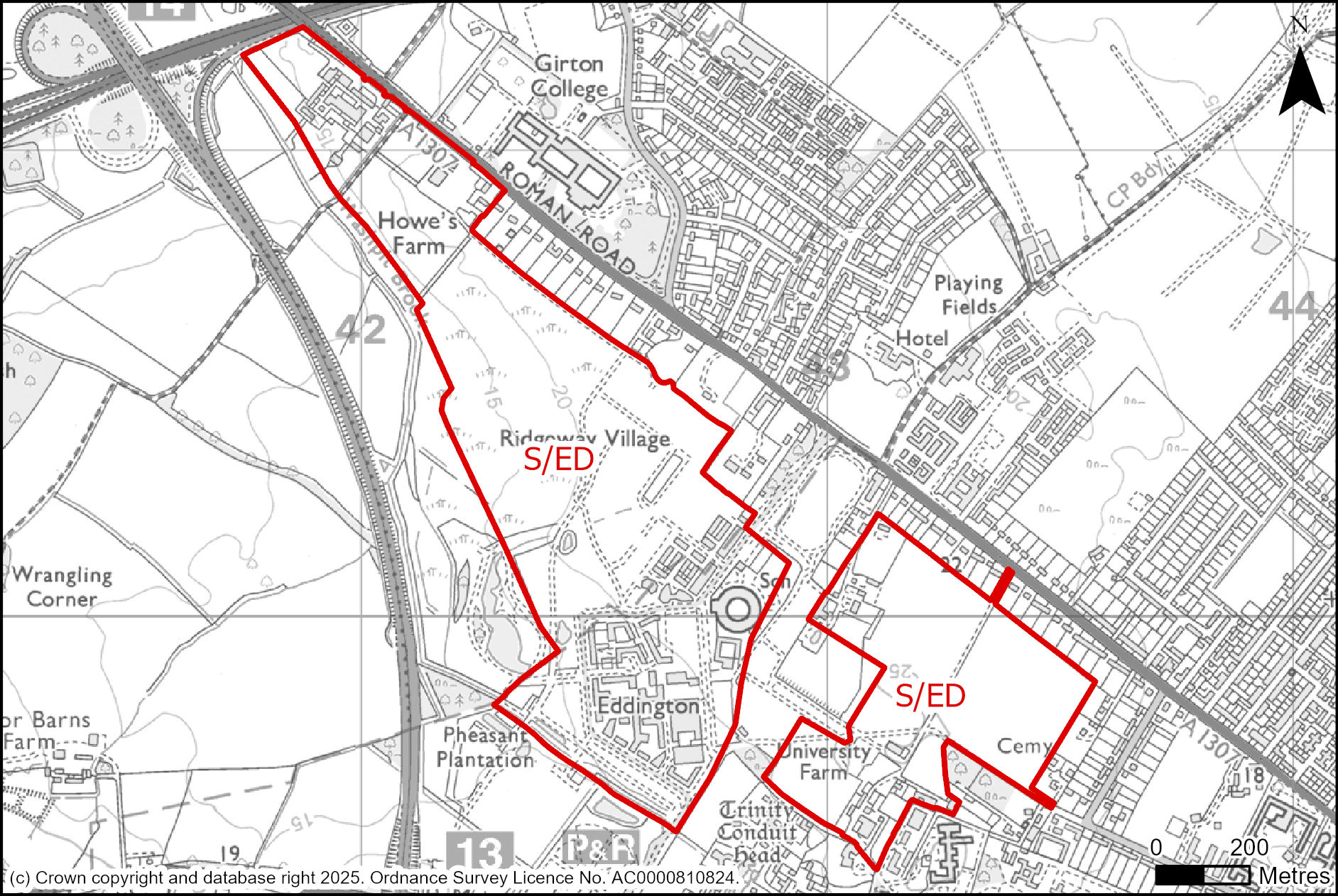
4. Eddington is allocated for mixed-use development as shown on the Policies Map and indicative Spatial Framework, comprising:
a. Approximately 5,500 dwellings, with Phase 1 (existing development) delivering 3,000 homes and Phase 2 (future development) delivering 2,500 homes. The mix of units will include:
i. 50% affordable housing, to meet the needs of Cambridge University and College workers at all levels (as distinct from student accommodation) and subject to evidence of need. The occupation of such housing will be limited to Cambridge University and College staff, including non-academic/teaching employees, in housing need;
ii. In Phase 2, 10% specialist accommodation (within Use Classes C2 and C3), including senior living accommodation, to meet the needs of older people or those with disabilities. This must be well integrated into the wider development.
b. Employment floorspace of approximately 100,000 square metres (gross internal area), comprising:
i. Up to 40,000 square metres for university related mid-tech/commercial research uses (within Use Classes E(g) and sui generis);
ii. At least 60,000 square metres academic floorspace (F1a).
c. Community facilities: indoor/outdoor meeting spaces, library, and sports facilities to support wellbeing and cultural needs and sized to reflect the increased number of dwellings;
d. Retail: provided in line with an up-to-date Retail Needs Assessment, including within neighbourhood hubs so that all residents have services and amenities within a reasonable 400 metre or 5 min walking distance.
e. Education: early years, primary, secondary, and sixth form spaces on-site or off- site as required;
f. Healthcare: facilities to meet local needs;
g. Faith space, allotments, community gardens, orchards, burial land, children’s play areas, and youth facilities (in accordance with a revised Youth and Play Strategy to be developed as part of the Phase 2 Outline);
h. Open spaces, landscaping, ecology areas and sustainable drainage systems (including greywater recycling).
The development of Eddington must do the following:
Context
5. Development must be contained to the established North West Cambridge site allocation of approximately 91 hectares, as shown on the Policies Map, ensuring:
a. Delivery of a high-quality landscaped edge to the Green Belt which preserves the unique character and setting of Cambridge, including key views from Strategic Viewpoint H: Redmeadow Hill, Barton;
b. The development respects and preserves key landscape and townscape features, including:
i. The wider skyline and settings of the Conservation Areas at Storeys Way, West Cambridge and Conduit Head Road;
ii. The setting of the Travellers Rest SSSI;
iii. The historic Ridge and Farrow field pattern;
iv. The avenue of Horse Chestnut trees and Veteran Oak in the centre of the site;
v. Mature hedgerows along field boundaries; and
vi. landscape features on the western edge.
c. Key watercourses are retained, including the Washpit Brook in the western part of the site and the reworked Chalk Marl in the eastern part;
d. An open gap with Girton is maintained, ensuring the separate identity of the village is retained.
Built form
6. The development of additional homes, student accommodation and student accommodation which go beyond existing outline planning applications must be comprehensively planned to ensure it is well-integrated with existing and consented elements of the site. Applications for further development must:
a. Create a varied and well-articulated skyline to the development that utilises building heights of up to and no more than 5 residential storeys;
b. Demonstrate that any taller buildings of more than 5 residential storeys create a positive contribution to the wider Cambridge skyline, justified through accurate 3D modelling and comprehensive landscape and visual impact assessment;
c. Be informed by a Landscape Visual Impact Appraisal and Heritage Impact Assessment. Be required to provide acoustic mitigation for homes affected by the traffic noise from the M11, A14, and Huntingdon Road.
Public space
7. Create green corridors and open spaces, which must link internally and with the landscaped area to the west of the site.
8. Provide strategic landscaping of the development to ensure that each part of the development area is well landscaped, managed and protected.
Nature
9. Provide green infrastructure to support biodiversity, climate resilience, and health and wellbeing.
10. A revised site-wide Biodiversity Strategy must be prepared to take account of any uplift in dwellings.
Movement
11. Provide highly walkable neighbourhoods that minimise car use and prioritise walking and cycling, by:
a. Integrating well with cycling and public transport routes;
b. Ensuring excellent permeability on foot and by bicycle; and
c. Safeguarding the role of ‘The Ridgeway’ as a strategic walking and cycling route, ensuring priority for walking and cycling within the development and good connections to strategic routes that link to nearby villages, the city centre and surrounding countryside.
12. Provide a comprehensive last-mile delivery strategy coordinated with West Cambridge.
13. Mitigate impacts on the existing public highway network through using a revised Transport Assessment that reflects the uplift in homes, employment floorspace, and other uses above those approved in outline planning permissions 11/1114/OUT and S/1886/11. This must:
a. Support sustainable, non-car based journeys including ongoing funding of University bus services;
b. Reduce car parking and provide a comprehensive car parking strategy;
c. Utilise car clubs, employee travel plans, residential travel planning;
d. Avoid net increases in vehicle trips on the strategic road network to achieve a modal share of no more than 40% of trips to work by car (excluding car passengers).
14. Continue to provide vehicular access from Huntington Road and Madingley Road, with no private motor vehicle access from Storey’s Way. Motor vehicular access for employment areas in the south-east and north-west corners must be provided to reduce commercial traffic through the main Eddington site.
15. Development will be subject to sufficient highway capacity being available to serve all stages of development, including on the adjacent strategic road network. Development will contribute to measures to mitigate any significant adverse traffic impacts on the M11, A14 and the surrounding highway network, if this is shown to be necessary by transport assessments. To support delivery of further development, a strategic and local transport mitigation plan must be prepared by the developer in consultation with the Local Highways Authority and Local Planning Authority.
16. Additional development at Eddington will be subject to a monitored and enforceable peak-hour vehicular trip budget. The indicative trip budget is approximately 1,700 trips in the AM peak and 1,750 trips in the PM peak. A refined trip budget based on more detailed evidence must be agreed with the Local Highways Authority prior to submission of the outline application. A monitor and manage approach will be taken to ensure that the development remains within the agreed trip budget for the site throughout its delivery.
Resources
16.A revised Surface Water Management Strategy must be prepared to manage the uplift in homes and provide 100% recycled water for homes, with on-plot water management utilising sustainable urban drainage measures, so there is no adverse impact on the water environment and biodiversity and to support a resilient and healthy community.
Lifespan
17. Delivery of Eddington (Phase 2) must be in accordance with:
a. A revised masterplan, parameter plans and site-wide design code, demonstrating an ambitious and innovative approach to placemaking with a holistic focus on health and wellbeing;
b. A revised Phasing Plan, to manage additional dwellings, student accommodation and employment land;
c. Other supporting strategies as required, including (but not limited to);
d. A revised Youth and Play Strategy to inform the appropriate provision of children’s play areas, and youth facilities;
e. A Sports and Open Spaces Phasing Plan.
18. The applicant must identify a proposed approach to the long-term management, maintenance and stewardship of infrastructure, services, and facilities not provided by statutory undertakers, including:
a. Car and cycle parking;
b. Sustainable surface water drainage;
c. Landscaping and open spaces;
d. Community buildings and indoor and outdoor sports facilities; and
e. Unadopted roads and parking enforcement.
19. The application must demonstrate measures to support community development, such as community development workers, to foster social cohesion.
Supporting information
Eddington should achieve a density of development that supports liveability in a compact, walkable, and sustainable urban form that promotes active travel and public transport use. The uplift in the number of dwellings and additional mid-tech use will support this but needs to be balanced with the need to respect and enhance the local landscape, townscape and heritage, informed by various evidence base documents.

The masterplan review will require testing and refinement of the site capacity, including testing building heights, to ensure taller buildings make a positive contribution to the Cambridge skyline, informed by the Greater Cambridge Skyline and Tall Buildings Strategy.
The Area Action Plan requires housing developments to provide 50% affordable housing to meet the needs of Cambridge University and College workers. This requirement will remain relevant to the densified scheme and is carried through the Greater Cambridge Plan, ensuring that new affordable homes are accessible to both academic and non-academic staff in housing need. The development strategy for Greater Cambridge is to direct any new homes, which includes specialist accommodation, to strategic sites on the edge of Cambridge and new settlements. Eddington will therefore need to respond to the variety of housing needs identified.
The policy continues to support delivery of academic and industrial floorspace. In particular, there is a demand for mid-tech commercial uses, for which this site is well suited due to the proximity of complementary employment spaces. The Eddington site adjoins the West Cambridge site, which itself is undergoing significant change. Policies seek a synergistic approach between these two sites, recognising that together they form a significant innovation district in this part of the city.
Development of this site can positively contribute to the character of the surrounding area and avoid visual negative impacts upon nearby designated and non-designated heritage assets and views from strategic viewpoints, by careful consideration of building heights, particularly limiting them to no more than 5 storeys height at the edges whilst further, plot specific testing will be required to demonstrate that taller buildings elsewhere within the site can be delivered without causing adverse harm to designated heritage assets, their setting as well as Strategic viewpoints.
The revised levels of development will need to be accompanied by investment in services and facilities to accommodate the additional needs generated. This will include for education, sports, community facilities and open space. For residential uses, acoustic mitigation is required to address noise from the M11, A14 and Huntingdon Road. Due to an anticipated revised masterplan to accommodate the uplift in development, a revised biodiversity strategy will be required.
By prioritising and supporting journeys by non-car modes of transport, the site will take advantage of its sustainable location and enable future occupants and users to commute to and from Eddington using sustainable modes of transportation. Similarly, this aim will be supported by safeguarding the role of the Ridge Way cycle/pedestrian route and requiring revised Travel Assessments. A densification of development is likely to result in additional highway and transport mitigation measures which will need to be identified in a strategic and local transport mitigation plan, prepared by the applicant and agreed with the Local Planning Authority and Highways Authority prior to submission of a new planning application. Additionally, the existing trip budget for the site will be refined as more detailed evidence is developed to support the revised masterplan, and a monitor and manage approach will be taken to ensure that the development remains within the agreed trip budget for the site throughout its delivery.
Cambridge University currently manages and maintains land and facilities at Eddington, but future arrangements need to be secured for the additional development. Generally, current site wide strategies for the approved development will need to be revised to include the additional development planned for in this policy.
The policy sets clear requirements for future development to protect existing forms of sustainable infrastructure networks on the site. This will ensure that the innovations that Eddington has previously delivered in relation to water and energy are capitalised upon. By linking to existing sustainable networks and ensuring that the site’s non-potable water system has sufficient capacity, the development will provide a positive contribution to efforts to reduce the Greater Cambridge’s carbon emissions and water usage. The requirement for the development to update the existing Water Conservation Strategy and possibly create a new one, will also support this aim. The policy requires an updated site wide Surface Water Management Strategy to ensure that the innovations previously delivered by the development are continued and improved upon.
Due to the level of change since 2009 the North West Cambridge Area Action Plan will be superseded by the new Greater Cambridge Local Plan and no longer form part of the development plan for the area.
Supporting topic paper and evidence studies
- Greater Cambridge Local Plan: Strategy Topic Paper
- Greater Cambridge Local Plan: Sites Topic Paper
- Housing and Economic Land Availability Assessment (2025)
- Greater Cambridge Employment Land Review & Economic Development Evidence Base (2020)
- Heritage Impact Assessment (2025)
Tell us what you think
We will consider all comments while developing the next version of the Local Plan.
All comments must be received by 30 January 2026 at 5pm.